
Watch the Lectures#
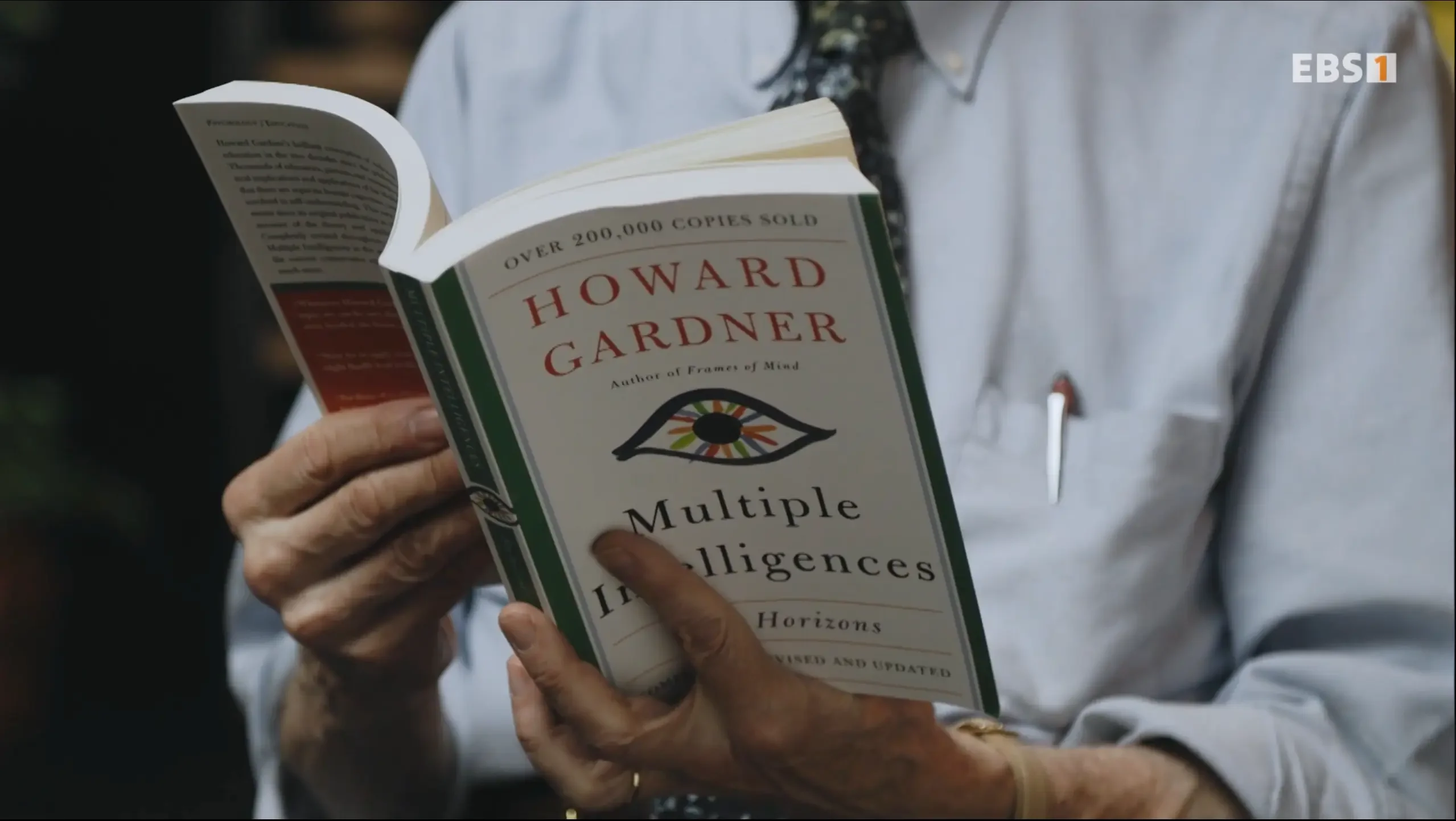
Howard Gardner - Multiple Intelligences Theory
- 1강 다중지능이란 무엇인가
- 2강 아이는 어떻게 배우는가
- 3강 지능이 높으면 창의성도 높을까
- 4강 지도자는 어떤 지능을 가졌나
- 5강 유능한 직업인이 되는 방법
Lecture 1: What Is Multiple Intelligence?#
IQ tests are conducted in schools, companies, and academic institutions to assess people's academic and work abilities. But are IQ tests really a suitable indicator that reflects human capability? Howard Gardner, a world-renowned education scholar who has earned enthusiastic support from parents and teachers worldwide, argues that to understand human abilities, we need more refined assessments that can examine the diverse aspects of being human, beyond IQ tests. Humans possess intelligence that encompasses not just mathematical and linguistic abilities (which IQ measures) but also artistic ability, spatial awareness, bodily-kinesthetic ability, interpersonal ability, intrapersonal ability, and more. In Lecture 1, "What Is Multiple Intelligence?", we explore the various types of intelligence humans possess and their characteristics.
Intelligence is a concept developed by Alfred Binet. He wanted to predict who would do well or poorly in school. Human intelligence isn't just one thing.
Lecture 1 Summary#
Multiple Intelligence Theory: A theory of intelligence that explains human intelligence as the result of various types of intelligence cooperating with each other.
Linguistic Intelligence: The ability to think and express through language
Logical-Mathematical Intelligence: The ability to exercise logical thinking and mathematical ability
Musical Intelligence: The ability to recognize and create musical elements
Spatial Intelligence: The ability to perceive and manipulate visual space
Bodily-Kinesthetic Intelligence: The ability to control and use the body
Interpersonal Intelligence: The ability to form relationships and understand others
Intrapersonal Intelligence: The ability to understand and reflect on oneself
Naturalistic Intelligence: The ability to observe and understand nature
Existential Intelligence: The ability to contemplate big questions
Lecture 2: How Do Children Learn?#
When Howard Gardner presented the theory of multiple intelligences to the public in 1983, numerous educators asked him questions. "If there are 7 intelligences, should we design 7 different lessons?", "Do we have to give 7 different exams?" In Lecture 2, "How Do Children Learn?", Howard Gardner answers the questions from parents and educators who encountered the theory. We discover how to identify which intelligence a child's brain specializes in, and what kind of education is needed to develop each child's specialized intelligence. He reveals the secrets of educational methods that can enhance children's intelligence, drawn from his firsthand observations and research in educational settings across the United States and the world.
Lecture 2 Summary#
The human mind is like a collection of multiple non-autonomous computers.
Intelligence Profile: The strengths and weaknesses of an individual learner's multiple intelligences.
Is it really possible to measure intelligence? -> It's difficult with simple IQ tests.
Each area of multiple intelligence theory requires a different method of measurement.
There are also two ways to apply multiple intelligence theory to education: individualization and pluralization.
Individualization: Finding out as much as possible about the child you're caring for. (Providing learning opportunities tailored to each child.)
Pluralization: No subject or topic should be taught in just one way. (Teaching in ways that support learners' growth, understanding, and application of knowledge.)
Lecture 3: Does High Intelligence Mean High Creativity?#
How were physicist Einstein, the great painter Picasso, and Russian musician Igor Stravinsky able to demonstrate their genius? Howard Gardner studied the intelligence of great historical figures to explore the relationship between intelligence and creativity. According to Professor Gardner's research, these geniuses show similar patterns in their lives. In Lecture 3, "Does High Intelligence Mean High Creativity?", we examine what multiple intelligences these world-famous geniuses possessed. We also explore their environments during their teens, twenties, and thirties, and discover the common intelligence development methods of geniuses -- the paths through which they developed their abilities.
Lecture 3 Summary#
Two questions Howard Gardner focused on:
- What is the relationship between intelligence and creativity?
- What is creativity for leaders, and what intelligence do leaders possess?
Creating obstacles can lead to creative behavior.
Mihaly Csikszentmihalyi (Howard Gardner's colleague): Don't ask what creativity is -- ask where it is.
Creativity isn't something inside humans. It's the interaction between people through knowledge and skills, and it manifests in a field of activity -- a 'domain.'
There are four levels of creativity:
- Big Creativity: A good subject for study and understanding -- people with this level of creativity are truly rare.
- Medium Creativity: Creativity that only has meaning when others recognize it. (Expressing something by choosing means, subjects, methods, and forms.)
- Small Creativity: Creativity most people can aspire to. (Planning a great party, a wonderful vacation, changing jobs.)
- Micro Creativity: Things you post on social media fall into this category.
If you want to be creative, you have to take risks. You have to try something, fail, try again, recover, and try once more. Don't get discouraged -- seek help from those around you. You need to be able to get knocked down and laughed at, yet get back up again. Most people can't do that.
In Confucian societies, the consequences of making mistakes and being embarrassed are severe, so it's much harder to exercise creativity in those cultures.
Lecture 4: What Intelligence Do Leaders Have?#
Like geniuses, world-famous leaders also share common characteristics in their multiple intelligences. In Lecture 4, "What Intelligence Do Leaders Have?", Howard Gardner uses 19th-century figure Abraham Lincoln, first-half-of-20th-century Mahatma Gandhi, and second-half-of-20th-century Margaret Thatcher as examples to explain the multiple intelligence characteristics of world-famous leaders. He also examines the essential leadership skill of media utilization. Through the actions of US presidents including Franklin Roosevelt, Barack Obama, and Donald Trump, he interestingly explores the connection between leadership and media skills.
Lecture 4 Summary#
A leader is a storyteller. A leader's story gathers so-called 'followers' and changes their thoughts and hearts.
Followers change their minds not because they're forced or paid, but because the leader's story is persuasive.
A leader doesn't just talk -- they must also embody what they say.
Lecture 5: How to Become a Competent Professional#
Throughout the latter half of the 20th century, Howard Gardner researched what multiple intelligence is and how human intelligence works. But the more he studied intelligence, the more he felt that how intelligence is used matters more. The intelligence we've developed throughout our lives -- how can we fully exercise it in our respective fields? In Lecture 5, "How to Become a Competent Professional", we consider the various problems we'll face in life and how to wisely solve them. Real cases of diverse professionals that Professor Gardner collected in the United States evoke empathy with the difficulties we face in the workplace.
Lecture 5 Summary#
How do people use their intelligence? Any intelligence can be used for good or for evil.
Good Work: Not just doing something skillfully, but having a purpose that is good and positive.
The Triple Helix of Good Work: Excellent (technically outstanding, the people doing the work are skilled), Engaging (draws people in, they want to do the work), Ethical (can't always be ethical, but strives to be, people who try to do the right thing even when it's hard)
Work that is technically excellent, draws people in, and happens in a positive, prosocial manner is called Good Work.
How to foster Good Work: Neighborly morality and role ethics.
Neighborly morality: The Golden Rule (treat others as you'd want to be treated) and the Ten Commandments.
Role ethics: Applies to professional situations. Finding the best course of action in a given circumstance.
A good citizen is someone who knows the laws and rules. A great person is someone who participates in and cares about society.
Solving dilemmas:
- Define
- Discuss
- Debate
- Decide
- Debrief
Follow these 5 steps in order to get help with difficult problems.
Jerome Bruner's three questions:
What makes humans human?
How did we become human?
How can we become more human?
Our kindness may be the most persuasive argument for that which we believe.
— Gordon Hinckley