Watch the Lectures#
Joseph LeDoux - The Neuroscience of Fear
- Lecture 1 A Scientist Who Studies Emotions
- Lecture 2 The Path to Fear
- Lecture 3 The Truth About the Amygdala
- Lecture 4 Fear and Anxiety
- Lecture 5 The Evolution of Emotions
Lecture 1: A Scientist Who Studies Emotions#
Lecture 1 explores how neuroscientist Joseph LeDoux came to study emotions and his methods.

The lecturer Joseph spent most of Lecture 1 explaining his background in becoming a scientist.
When you split the brain, you can see white matter on the inside of one half. This part is the corpus callosum — a bundle of nerve fibers or axons.
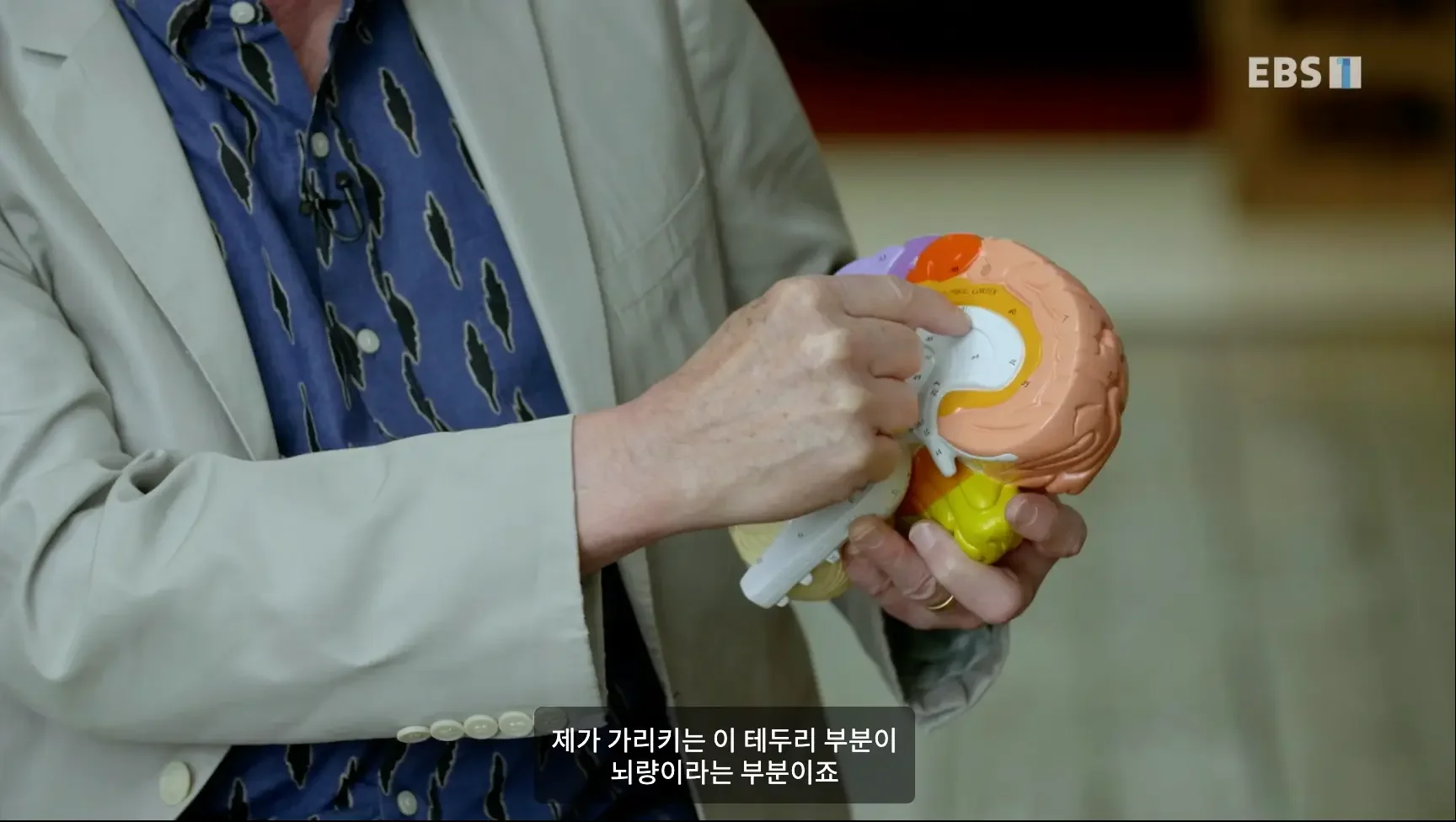
Language is primarily handled by the left brain here. The right brain handles all other abilities like stimulus detection, perception, and behavioral regulation.
Behavior continuously happens unconsciously, but since we feel we have free will, we need to understand those behaviors. So when our body does something beyond our control, our consciousness gets uneasy. That's why our consciousness has the ability to create stories to explain our behavior.
We constantly make up these stories, and one of the key brain systems involved in doing this is probably the emotion system.
Lecture 1 Summary#
Corpus callosum
- A bundle of nerve fibers connecting the left and right cerebral hemispheres
- Contains over 200 million nerve fibers
- Nerve cells in the corpus callosum connect the left and right brain
Left brain
- Handles language and various other activities
- Creates stories to explain behavior when it can't consciously interpret unconscious actions
Right brain
- Handles various activities except language (analysis, stimulus detection, behavioral regulation, etc.)
- A person cannot speak with only the right brain
Split-brain patients
- Severe epilepsy patients whose seizures are difficult to control
- Confirmed through split-brain patients that information flows within the brain
Psychological characteristics observed in split-brain patients
- Both sides of the brain operate in isolation
- Information seen by the split-brain patient's right brain cannot be transmitted to the left brain, so they cannot answer verbally
- The right brain can direct the left hand to pick up an apple
Brain -> Information flow system
- Information entering one side of the brain goes to the opposite side to regulate bodily responses
- When both sides are separated (as in split-brain patients), the information flow is cut off
Lecture 2: The Path to Fear#
Lecture 2 explores what fear is and through which organs and processes people experience it.
I participated in the research of Professor Donald Reis at Cornell Medical School, who was studying the mechanisms by which the brain regulates blood pressure. I decided to study the emotional behavior of rats and find ways to measure blood pressure, and I chose an experiment called "fear conditioning."
For example, you play a specific sound for a rat and immediately give it a mild electric shock. The sound is the conditioned stimulus and the electric shock is the unconditioned stimulus — the condition is formed that these two appear together. The sound is a weak stimulus and the electric shock is a strong stimulus.
We already knew that just the sound would produce a freezing response. When we measured blood pressure, we also discovered that the sound regulated blood pressure and heart rate. So we decided to follow the path sensory information takes as it moves to the brain.
The brain is a kind of information flow system. When information enters one side of the brain, it usually crosses over to the other side, where it regulates responses. We used anatomical methods to see how parts of the brain connect to each other. This method is called pathway tracing — following the connections from one part of the brain to another. We also created brain lesions.
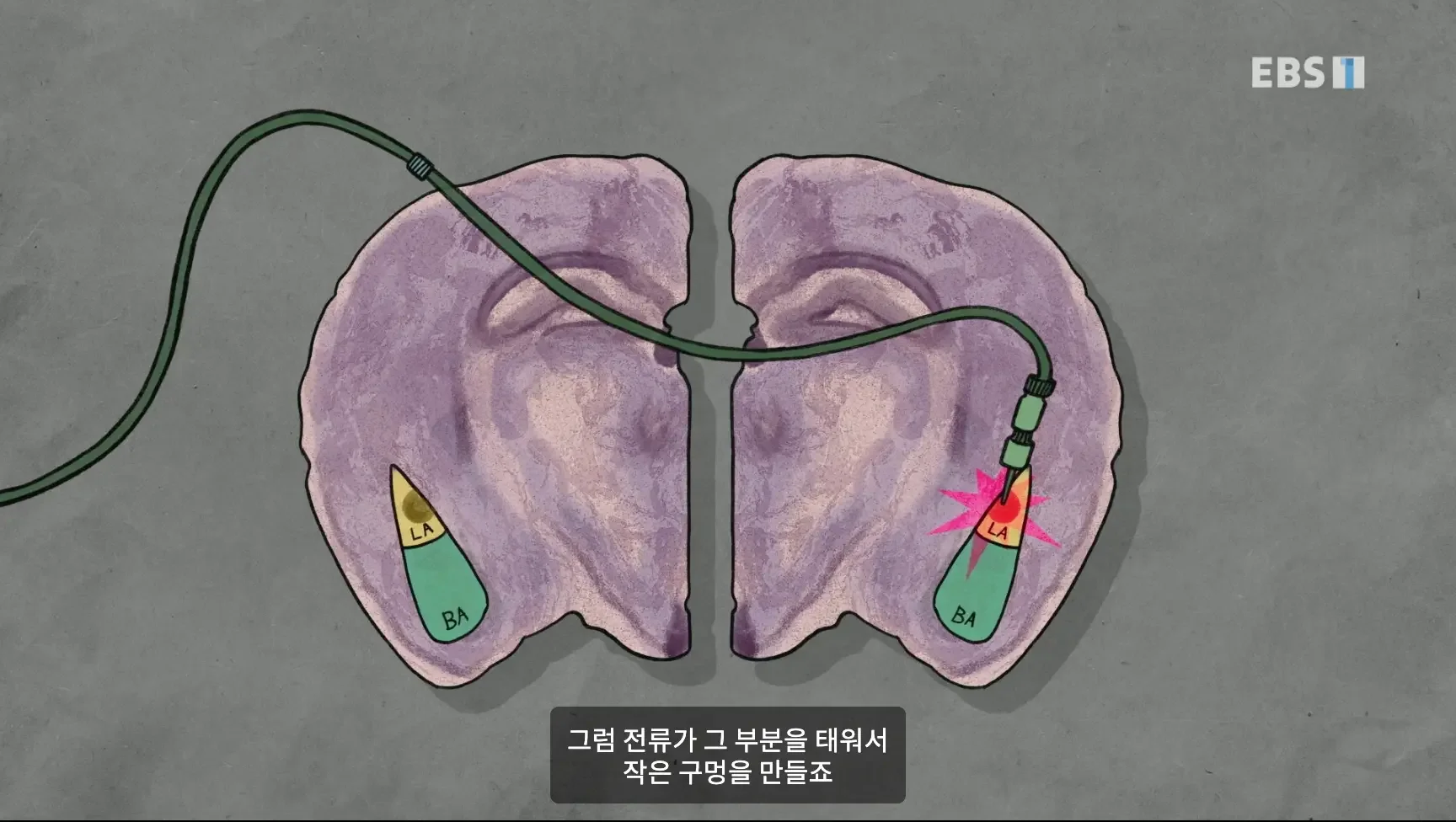
To create brain lesions, if a certain area is important for the specific behavior being studied, you insert an electrode there and run a small electrical current. The current burns that part, creating a small hole. The current destroys the part of the brain that regulates a specific behavior. Then they may not be able to perform the behavior they used to. If the behavior stops when that area is damaged, you can infer that the damaged area is relevant.
We're talking about how information is transmitted in the brain so that just hearing a sound associated with electric shock can make you freeze and elevate blood pressure and heart rate. For this to happen, sound information must be transmitted from the ears to the muscles controlling behavior, blood vessels controlling blood pressure, and the heart controlling heart rate. The amygdala makes this possible. The amygdala turned out to be the crucial part of the brain that combines shock and sound.
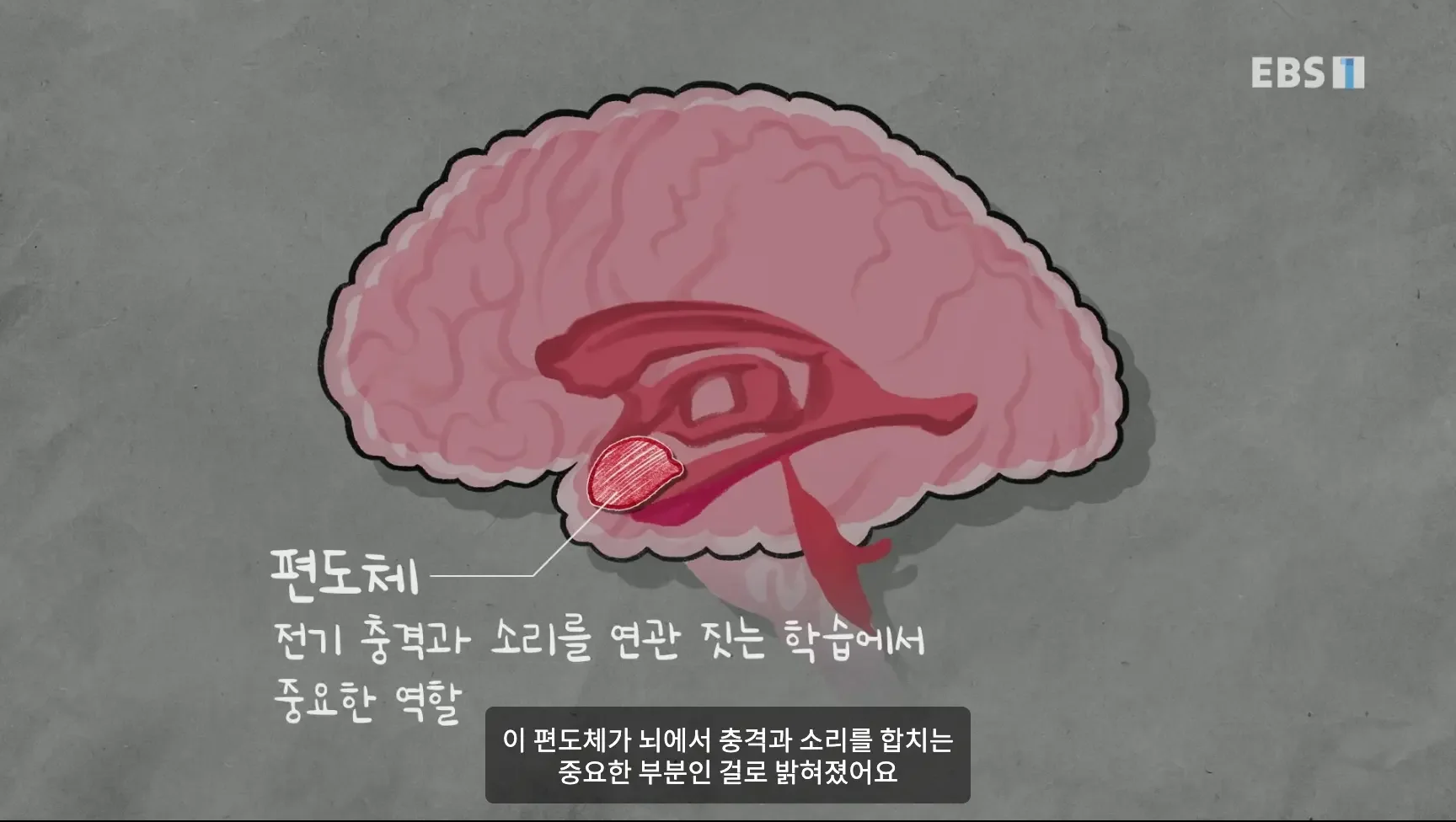
The thalamus and amygdala are directly connected, allowing stimulus information to regulate responses more quickly. It also goes to the auditory cortex, but that takes longer. We call the two pathways the fast path and the slow path. The fast path connects from the visual thalamus to the amygdala, creating behavioral and physiological responses. The slow path through the cortex is slower but can process more information. It can handle complex information processing too. It's what makes humans conscious of stimuli.
Behavioral and physiological responses to threats in the world can occur without going through the cortex — just through the thalamus and amygdala.
Implicit fear is generated when stimuli go directly from the thalamus to the amygdala. The stimuli reach the amygdala unconsciously, triggering responses.
Explicit fear relies more on the cortex. Stimuli travel from the visual thalamus to the visual cortex, then to other cortical areas, producing a more conscious sense of fear and conscious fear experience.
Lecture 2 Summary#
Amygdala
- An important area for producing appropriate responses to the environment, located in the brain's temporal lobe
Subliminal stimulus experiments made it possible to distinguish between implicit and explicit fear
- Implicit fear: Unconscious response to stimuli
- Explicit fear: Conscious fear emotion and experiential awareness
Two pathways through which sensory information leads to responses:
- Implicit fear -> Thalamus -> Amygdala -> Fast pathway operates unconsciously
- Explicit fear -> Thalamus -> Cortex -> Amygdala -> Slow pathway operates consciously
Brain experiment methods:
- Fear conditioning experiment: An experiment that trains association with a scary stimulus to trigger fear responses
- Pathway tracing experiment: Tracing the travel path of stimulus information, tracking how information is transmitted in the brain
- Lesion experiment: Damaging a specific part of the brain to determine its relationship to specific behaviors
- Neurophysiology experiment: Inserting electrodes into the brain, observing neural cell activity, and measuring neural activity
- Subliminal stimulus experiment: An experiment proving that unconscious responses can occur even when stimuli aren't consciously perceived
Lecture 3: The Truth About the Amygdala#
Lecture 3 — While people have been told the amygdala is where fear is felt, Joseph LeDoux says we need to distinguish between the emotion of fear and the response to fear.
Until the early 1980s-1990s, the amygdala wasn't well known. It became very popular in the business world with the concept that the amygdala could hijack responses in dangerous situations.

When we have information about people's behavioral or physiological responses and ask them what emotion they feel, some say they were really scared. But when we look at their heart rate measurements, it wasn't beating that fast. Sometimes they don't look scared but say they are, and sometimes they seem scared but actually aren't.
If the amygdala controlled all responses and produced the emotion of fear, there should be a clear correlation between the two — but the correlation was weaker than expected. The amygdala is the center of implicit fear.
Rather than thinking of the amygdala as the fear circuit, let's think of it as a defensive survival circuit. The amygdala doesn't react because it feels fear — it unconsciously detects danger and produces responses. We call this the implicit defensive survival circuit.
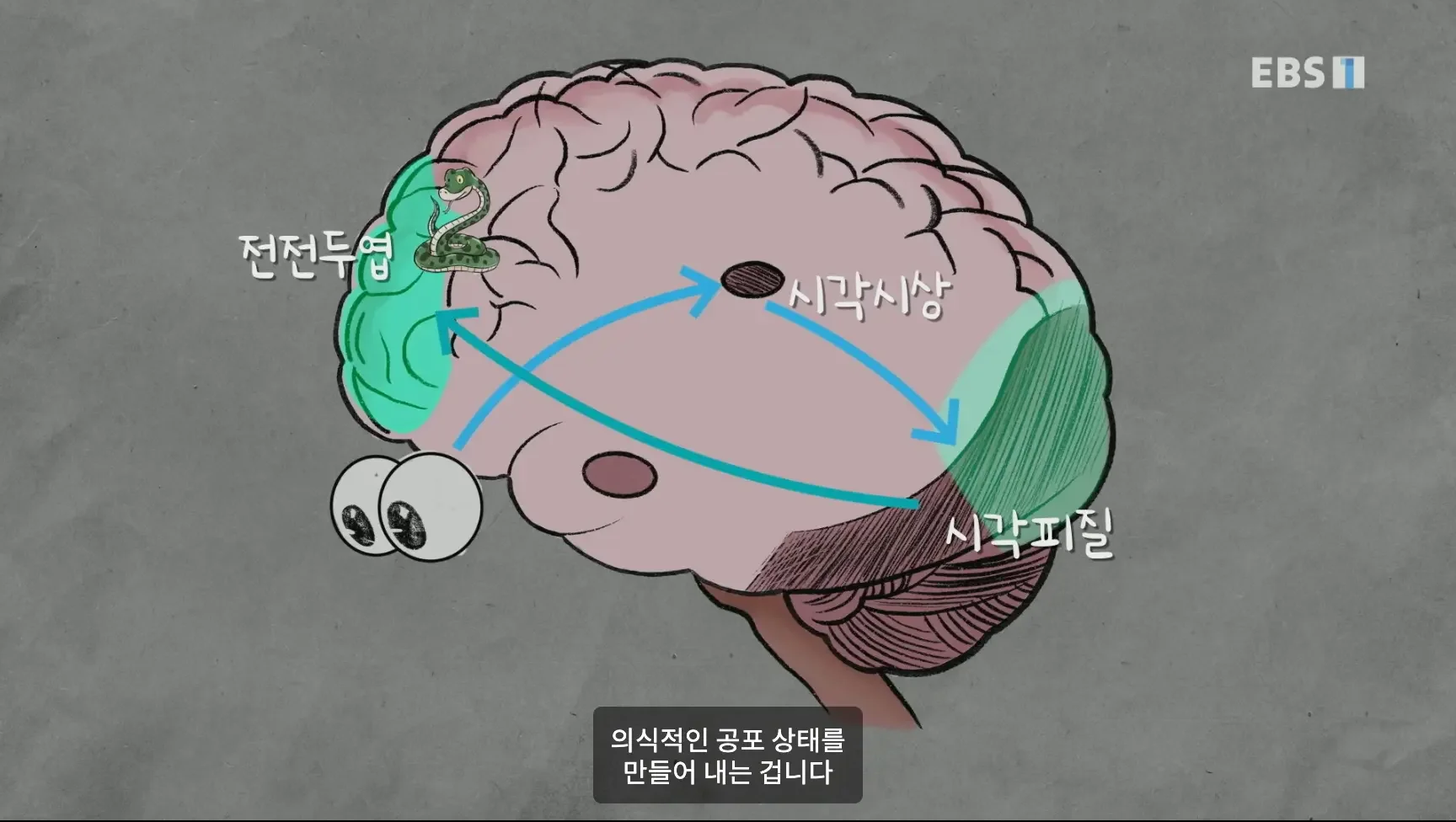
The amygdala detects danger and produces responses. Conscious fear is a completely different concept. It's generated when visual stimuli are transmitted to the visual cortex, then goes to the prefrontal cortex at the front of the brain to create a conscious state of fear.
Working memory is the place where all kinds of information (various experiences of seeing, hearing, smelling) merge into a unified experience. Working memory combines memories of an apple with physical characteristics like the apple's shape to create the ability to recognize it again. If the stimulus is emotional, working memory needs information to process.
Emotional schemas are a kind of memory — memories of emotions you've experienced throughout your life. What emotions are, what fear is, what danger is, how you respond to danger, how likely you are to respond in certain ways, how others respond, what it means to be afraid — all of this is part of the emotional schema.
When you see something dangerous like a snake, the emotional schema's role is to transform this information into a conscious experience of a dangerous stimulus. This is what working memory and the prefrontal cortex do for us — they create complex emotional experiences. You also need self-memory or self-schema. You remember emotions through things that happened to you.
Lecture 3 Summary#
Amygdala hijack
- A phenomenon where the amygdala hijacks responses, causing excessive emotional reactions that don't match the actual stimulus
Why the amygdala isn't the center of fear:
- You can feel fear but show no physiological response: The amygdala is the center of implicit fear, but it's mistakenly thought to be the center of all fear
- You may not feel fear but still show physiological responses: Danger responses and conscious fear emotion are different; the amygdala is an implicit defensive survival circuit (implicit fear detector)
- Fear can be felt even with a damaged amygdala: It's where threats are detected and defensive responses are produced
Conscious fear
- Generated when visual stimuli go to the visual cortex
- A conscious fear emotion is created when visual stimuli travel from the visual cortex to the prefrontal cortex
Working memory (mental workspace)
- Where conscious emotions are created
- Related information is integrated into a single experience
- Visual information like shapes and colors from the visual cortex are unified
Emotional schema: A bundle of memories about emotions one has experienced. Schemas that integrate with information to create conscious experiences.
Self-schema: A bundle of memories about oneself as the subject of thought.
Emotional schema + Self-schema = The self & cultural schema that transforms danger into fear experiences. Fear experiences arise not from the amygdala but from cognitive processes.
Lecture 4: Fear and Anxiety#
Lecture 4 explores methods for distinguishing fear from anxiety and whether we can scientifically differentiate them through the bodily responses to these two emotions.
I want to talk about the trouble caused by people using fear and anxiety interchangeably or misunderstanding their definitions.

Sigmund Freud also distinguished between the two. When Freud spoke of fear, he used the word "Furcht," meaning danger is currently present. Meanwhile, "Angst" refers to worry or dread felt without any specific entity or particular situation. This is the general interpretation of fear and anxiety.
When there is a specific entity that could harm you, the resulting emotion is fear, but anxiety is closer to worry or concern about something that hasn't happened yet. It may not even be real.
Danish philosopher and theologian Soren Kierkegaard said anxiety is an essential element of a successful life. Without worrying about what the future holds, there's no progress in life. Kierkegaard also said anxiety is the price of freedom of choice.
In real life, we might think of anxiety as something we feel when we make choices and engage in high-level cognitive thinking. I think anxiety is the price of having a prefrontal cortex — the part of our brain where information gathers, decisions are made, and the future can be envisioned.
Emily Dickinson said this:
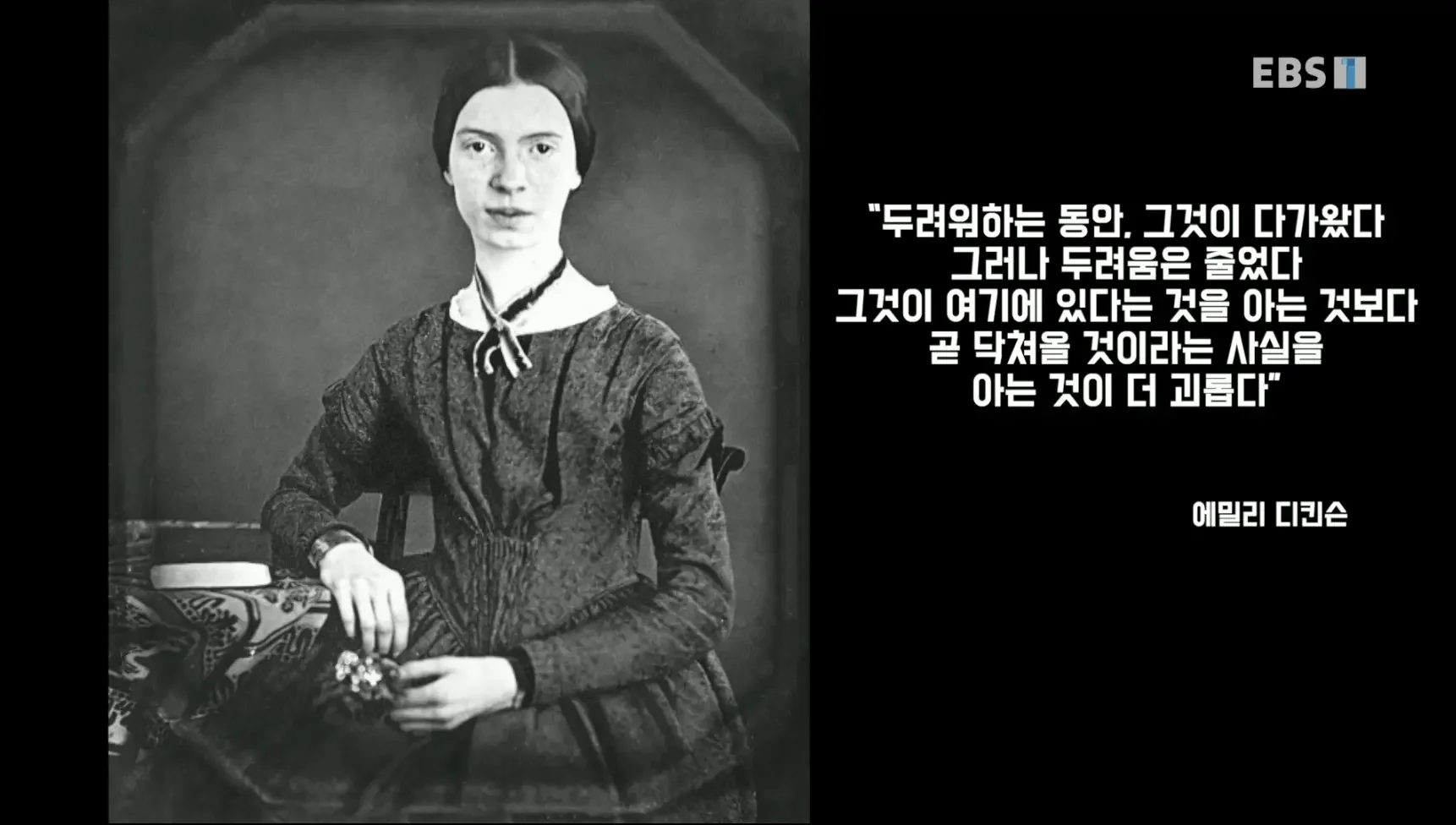
While I was fearing it, it came, But came with less of fear. To know it was coming was worse than knowing it was here.
Dickinson said the actual fear situation isn't that bad. The worst part is waiting for fear — the prefrontal cortex's anticipation of something that might happen, that anxiety of the unknown.
The similarity between fear and anxiety is that both pose a kind of threat to physical and psychological stability. The difference, as I mentioned, is whether the threat currently exists or is anticipated, and whether it's temporary. An emotion about a present stimulus is fear; if it's a long-lasting emotion not dependent on a specific stimulus, it's anxiety. When you feel fear, the threat is here and now. When the threat disappears, fear goes away. Anxiety, on the other hand, exists conceptually rather than physically, so it can be considered always present.
An interesting fact about fear and anxiety — perhaps all emotions — is that they have set points. Everyone has their own set point for feeling certain kinds of emotions. Some people's anxiety level is very low while others' is high. For those with high levels, anxiety constantly comes and goes, and some anxiety stays and never leaves.
Fear and anxiety are so similar that drawing a clear line between them isn't easy.
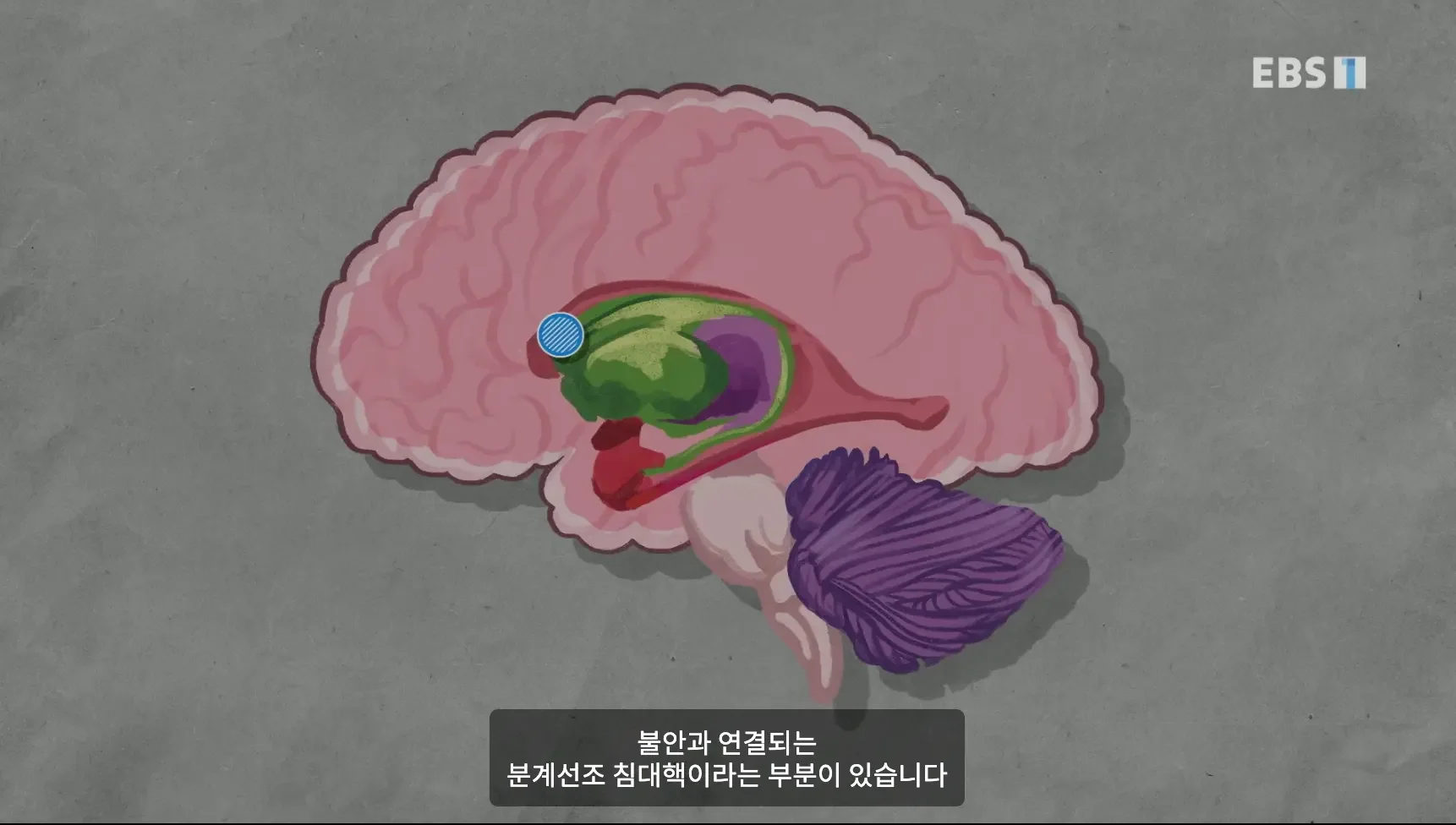
In the brain, just as the amygdala is connected to fear, there's a part connected to anxiety called the bed nucleus of the stria terminalis (BNST). Both the amygdala and BNST are responsible for the behavioral and physiological responses that appear when feeling fear or anxiety. However, fear or anxiety emotions don't necessarily trigger responses. That doesn't mean behavioral and physiological responses don't influence conscious emotions — they do. Emotions and responses aren't perfectly independent.
Anxiety is a perfectly normal part of daily life. We all experience some degree of anxiety, but not everyone has an anxiety disorder. An anxiety disorder is a state where anxiety occurs so frequently and intensely that it interferes with daily life.
Generalized anxiety disorder involves excessive worry or nervousness that prevents concentration and causes constant fatigue.
Panic disorder makes you worry about when the next panic attack will happen. Palpitations can develop — feeling your heart racing, sweating, and trembling.
Social anxiety disorder is a social phobia showing fear responses in situations with other people. There's also agoraphobia — fear felt in open spaces or public places where you feel unprotected.
I believe we need to think about psychological treatment from the perspective of brain systems. We have subcortical circuits that control behavioral and physiological responses, and cortical circuits that create the stories that become conscious experiences.
Lecture 4 Summary#
Sigmund Freud: Distinguished between fear and anxiety
- Fear (Furcht): Danger that exists here and now
- Anxiety (Angst): Worry, dread felt without a present object
Joseph LeDoux:
- Anxiety is the price of having a prefrontal cortex
Fear & Anxiety
- Fear triggered by a threat transforms into psychological anxiety
- Frequently anxious people find threatening stimuli and feel fear
- Everyone has different set points
- People with high anxiety set points -> Feel anxiety more frequently and for longer duration
Similarities: Both threaten physical and psychological stability
Differences: - Fear: Temporarily exists here and now -> Caused by actual stimuli
- Anxiety: Persists when anticipated -> A long-lasting emotion without specific stimuli
Distinguishing fear and anxiety: Scientifically useful
- Doesn't always produce physiological responses
- Responses and emotions are separate outputs from different circuits
- Emotions and responses aren't perfectly independent
- Fear emotion doesn't always accompany responses
Bed Nucleus of the Stria Terminalis (BNST)
- A brain area known as the center of anxiety, also called the extended amygdala
- Not the source of anxious feelings, but the place that produces responses to anxiety
Types of anxiety disorders:
- Generalized anxiety disorder: A disorder involving uncontrollable, irrational worry about various everyday topics
- Panic disorder: A disorder with recurring episodes of sudden, overwhelming anxiety — panic attacks
- Palpitations: Symptoms where heartbeat is unpleasantly perceived
- Phobia: An anxiety disorder involving excessive fear of and avoidance of specific objects or situations
- Social anxiety disorder: A condition involving persistent fear or anxiety in social relationships or situations
- Agoraphobia: A condition involving fear of being alone in open spaces or public places
Post-Traumatic Stress Disorder (PTSD): A condition where severe events like war or torture are re-experienced mentally, causing extreme fear
Obsessive-Compulsive Disorder (OCD): A pathological state of unwanted, compulsive thoughts and behaviors
Paranoia: A pathological state of systematic and persistent specific delusions
Treatment for phobias and anxiety disorders -> Subjective experience must be changed
- Psychotherapy
- Cognitive Behavioral Therapy (CBT): A method of correcting distorted cognition to change behavior and beliefs
- Pharmacotherapy: Effective for only 3/4 of patients
Animal research on fear & anxiety
- Emotions like fear and anxiety cannot be known through animal research
- Animal research can only reveal behavioral and physiological responses
- Medications obtained through animal experiments may be useful for taming behavioral and physiological responses
Changing experience -> Taming the amygdala
Subliminal stimulation
- Applying stimuli so quickly they can't be consciously perceived
- Showing feared objects as subliminal stimuli can change amygdala responses
Two survival circuits -> Understanding the difference enables effective fear & anxiety disorder treatment
- Subcortical circuit controlling behavioral and physiological responses (fast pathway)
- Cortical circuit controlling conscious experience (slow pathway)
Lecture 5: The Evolution of Emotions#
Lecture 5 examines when human emotions first existed and how they came about through Joseph LeDoux's evolutionary perspective.
In this final lecture, I want to talk about behavioral and physiological responses and when they began in evolutionary history. American writer Ralph Waldo Emerson said, "As soon as there is life, there is danger."
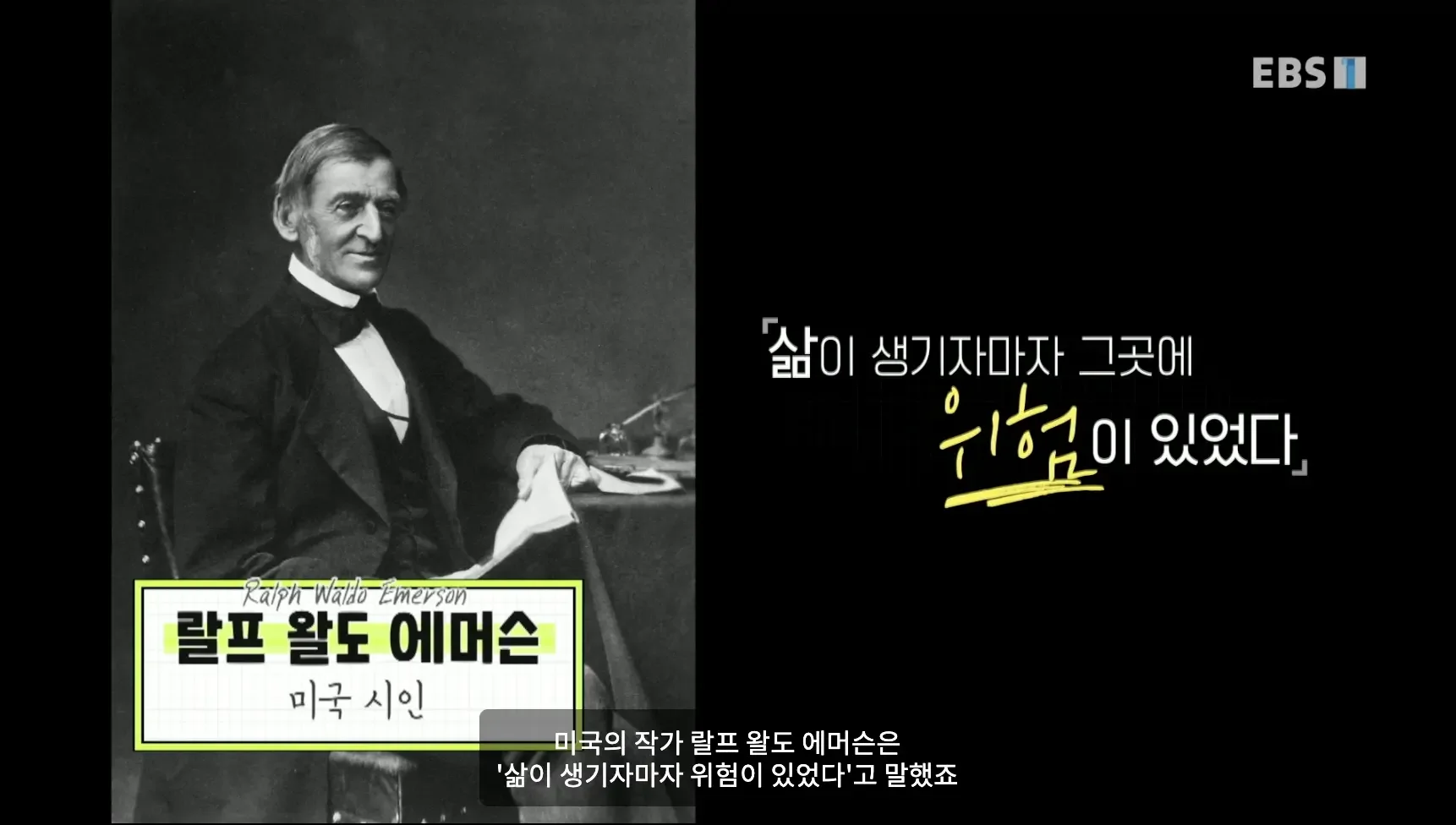
What is life? Life is just a chemical reaction, or a collection of chemical reactions. The interesting part is how this happened.
When life first began, RNA (RiboNucleic Acid) and DNA (DeoxyRibonucleic Acid) existed only in the ocean. Some of them got stuck in holes in rock. Inside these rock cavities, RNA and DNA became trapped in hydrogen sulfide gas. RNA and DNA began replicating, and as hydrogen sulfide gas bubbles rose from beneath the rock cavities, they formed a kind of membrane and escaped into the ocean.
According to this hypothesis about the origin of life, that's when the first cell was born. This first primitive cell — enclosed in a membrane, containing RNA and DNA with the ability to replicate — is called LUCA (Last Universal Common Ancestor), the common ancestor of all living things. Every cell that has existed since is a descendant of that first cell, LUCA.
I wanted to know when danger and threats first appeared in evolutionary history. The fact that the molecules that create memory in snails, flies, and other invertebrates and mammals are identical tells us they were inherited from a common ancestor.
Protozoa don't even have a nervous system — they have just one cell. They're literally a single cell. But protozoa learned. They remembered, accessed nutrients, and avoided harmful things. Protozoa have no nervous system, but they learn, store information, remember, and act. We think that psychology creates behavior — that there's a reason behind our actions.
The point is that the behaviors we often think come from psychology, that we believe are mental, actually have nothing to do with the mind. Behaviors like eating or sensing danger are part of an organism's survival toolkit. An organism is a living entity. Every cell is an organism. We all have cells, and every cell performs behaviors unrelated to psychology.
Cells had to perform five behaviors to survive: detect threats, ingest nutrients to create energy, balance fluids and electrolytes (without the right amount of salt and water, cells burst or shrivel), regulate temperature (since all chemical reactions inside cells depend on temperature), and reproduce for the survival of the species.
When we detect danger, we feel fear. When there's an energy imbalance, we feel hunger. When our fluid balance is disrupted, we feel thirst. When we're too cold, we warm up and feel warmth. When we reproduce, we talk about sexual pleasure. All of these are our emotions — states we create as we live.
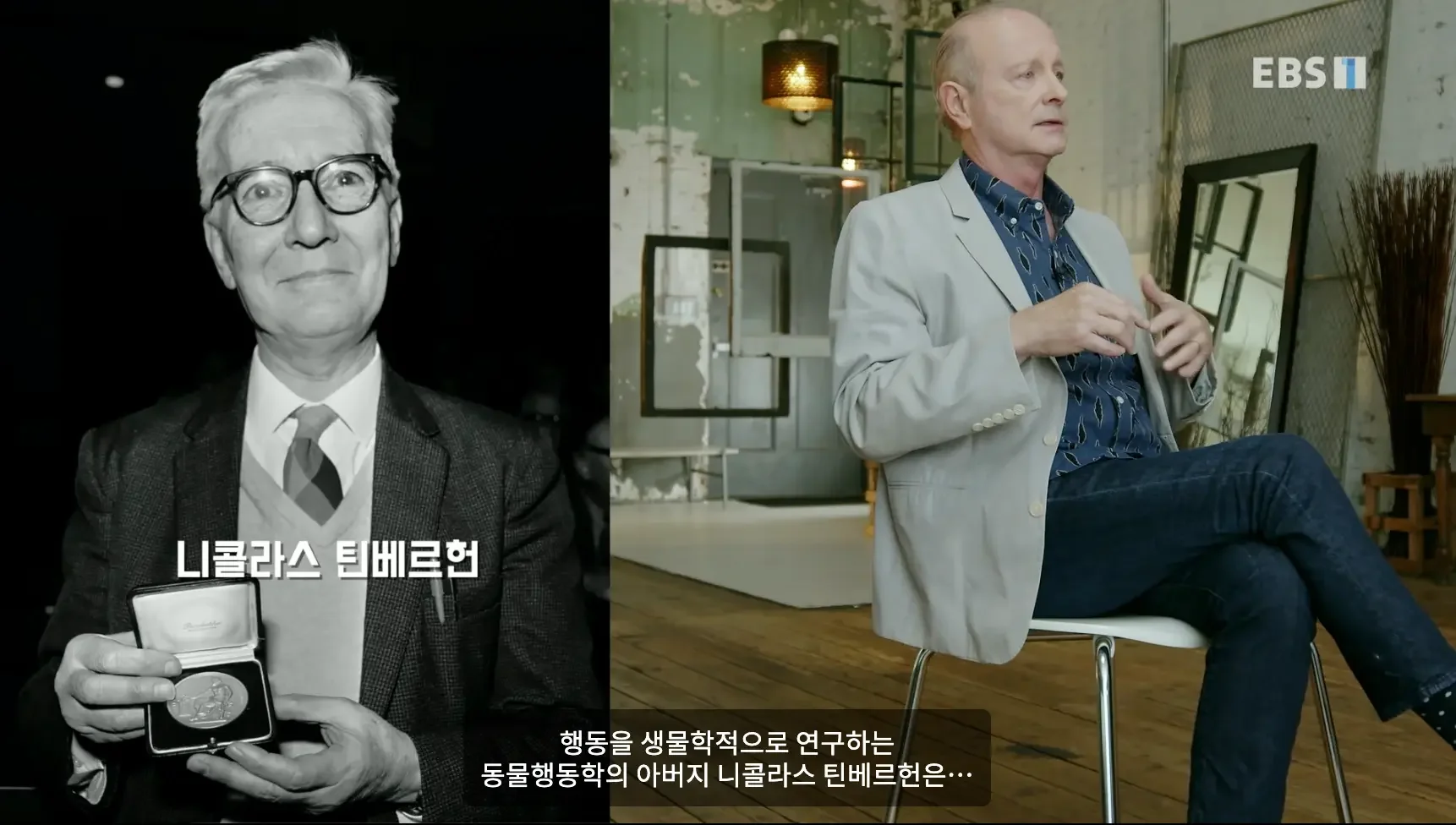
They're states we tell ourselves and others about. We still don't know if other animals have these states. Animal behaviorist Nikolaas Tinbergen said that speculations about the mental states or subjective experiences of other species are just speculations. The only way to properly know about mental states is self-reflection. Only rats know rats' mental states, and only humans know humans' mental states.
Our conscious emotions are extremely important. Emotions are the source of our greatest achievements — literature, art, medicine, music — and everything we enjoy and appreciate as humans is thanks to our conscious emotions. But our conscious emotions also create our most terrible and despicable traits as a species — greed, jealousy, supremacism, and narcissism.
The future depends on the decisions we make today.
Lecture 5 Summary#
What is life?
- Chemical reactions or a collection of chemical reactions
- All chemical substances are cosmic dust from the Big Bang
Earth's starting point -> Only simple physical and chemical reactions existed
- Elements in the periodic table are products of the Big Bang that fell to Earth
How did life begin? RNA and DNA emerged through complex chemical reactions
Common ancestor of all life: LUCA (Last Universal Common Ancestor)
- Invertebrates and mammals inherited the same molecules from a common ancestor
Flatworms: One branch from a common ancestor 630 million years ago
- Invertebrates: flies, worms, snails, etc.
- Vertebrates: fish, amphibians, reptiles, birds, mammals
Protozoa are the ancestors of all animals
- Just a single cell without a nervous system, yet capable of learning
- Learn to access nutrients and avoid harmful things
Survival strategies of bacteria and humans:
- Detect threats
- Ingest nutrients
- Balance fluids and electrolytes
- Regulate temperature
- Reproduce
Simple cells & complex humans have similar survival strategies.
Species that have evolved with their own survival methods throughout history
- New species that survived with new bodies and survival methods
- When environments change, new species suited to new environments can emerge
- However, survival strategies are the same in the big picture
The mistake of equating drug development based on animal behavior with human psychology
- Animal research can only reveal behavioral and physiological responses
- Human psychology and behavior are controlled separately -> Many of our behaviors have nothing to do with the mind
- Human experiences cannot be projected onto other animals
- We need to be more careful when explaining animal behavior through mental states