
Watch the Lectures#
Robert Weinberg - Cancer
- Lecture 1 What Is Cancer?
- Lecture 2 What Causes Cancer?
- Lecture 3 How Does Cancer Proliferate?
- Lecture 4 How Does Metastasis Progress?
- Lecture 5 How Can We Treat It?
Lecture 1: What Is Cancer?#
Robert Weinberg, who first discovered cancer genes, reveals the secrets of cancer cells. We commonly think cancer is caused by viruses invading from outside the body.
But Robert Weinberg says cancer doesn't come from outside — it starts inside the body.
The colon cancer, breast cancer, and liver cancer we know about all actually begin in the body's cells.
So how do normally functioning cells become cancer cells?
To find the answer, Robert Weinberg starts from the fundamental principles of biology.
And he explores what mutant genes — the prime suspects in creating cancer cells — are, and how mutations are born.
What is cancer?
What is the essence of cancer?
How does cancer form?
The first thing we need to understand is that cancer is not an external invader entering from outside our body — it starts in our body's tissues. Cancer is a disease caused by cells proliferating at the wrong time and in the wrong place. Cancer can be called a cellular disease. Cancer grows increasingly aggressively — this is what we call a tumor.
An initial cell goes through a series of changes and gradually develops aggressive characteristics. These aggressive cells grow into increasingly abnormal cell clusters. These abnormal cell clusters eventually form tumors, which proliferate at the site where the whole process first began. Over time, they may also invade adjacent tissues. This process is called cancer progression.
The important thing here is that with each growth stage, cancer cells become increasingly abnormal. As their abnormality increases, cancer cells develop into cell clusters. And the clusters grow into tissue — we call this entire tissue a tumor. At this point, the complexity increases even further because cancer cells that have gone from normal to highly abnormal acquire a series of mutant genes.
Abnormal cancer cells are driven by a single motive. They're only interested in self-proliferation — making more copies of themselves. Cancer cells have absolutely no interest in creating normal tissue or performing normal functions.
Proteins govern the complex life activities on this planet through biochemical reactions and structures. The paradigm where DNA makes RNA and RNA makes proteins is the fundamental rule that governs our lives.
Lecture 1 Summary#
Cancer
- A disease where abnormal cells proliferate at the wrong time and place
- Starts inside the body
- A disease that creates abnormal cells and tissues
Tumor
- Abnormal cells form tissue
- Grows aggressively through cancer stages
- Acquires mutant genes as it develops into abnormal cells
Mutant genes
- The root cause of cancer cells
- The growth stages of cancer cells are cancer progression
- As cancer cells grow, the degree of abnormality increases
To understand why cancer occurs, we need to understand changes in base sequences
ACGT base sequence changes -wrong instructions-> Abnormal cell proliferation
ACGT base sequence changes -> Determine the complexity and diversity of life
Only some of the 20,000 genes influence cell proliferation decisions
Proteins govern life activities
Even minor changes in base sequences caused by mutant genes can alter protein function and affect cells
DNA -> RNA -> Protein
Lecture 2: What Causes Cancer?#
Robert Weinberg, who first discovered cancer genes, reveals the secrets of cancer cells. Countless DNA replications occur throughout our lifetime.
DNA replication, which occurs every time a cell divides, is an essential process for maintaining life.
Occasional "mistakes" happen during this process — we call them "mutations."
Robert Weinberg explains that the possibility of mutation always exists throughout our lives.
Beyond mistakes during DNA replication, there are various other reasons mutations can occur.
They can happen during chromosome division, from UV exposure, or from smoking.
How do these seemingly minor "mistakes" end up forming life-threatening tumors?
What exactly has to happen for cancer to develop?
When mutations occur in a cell's key genes, the damaged mutant genes start commanding the cell. They command it to proliferate abnormally even when it shouldn't. This mutant DNA — this damaged genetic information — is the core of cancer development.
Let's look at DNA's double helix structure. DNA is composed of base pairs. A pairs with T, and C pairs with G. G pairs with C, and T pairs with A. This is what normal DNA structure looks like. A change in DNA structure means the order of these letters — the base pairs — has changed.
Understanding what happens during cell division is very important because when a cell divides, it must distribute the DNA double helix equally to two daughter cells. As the double helix unwinds and separates, these two strands are replicated to become the daughter cells' helices. But sometimes mistakes happen. Due to the replication complex, an incorrectly replicated letter may appear in the newly replicated helix's base sequence. This incorrectly replicated base is a mutation.
Even more terrible mistakes can occur. During DNA replication, one of the two strands being replicated can be cut. This break can be a catastrophe for the DNA double helix structure — such mistakes are far more serious and harder to fix than others.
Every time a cell grows and divides, about 2 billion bases are replicated, with about 3-5 bases being incorrectly replicated.
Cells have special proteins on their membranes called receptors. These receptors are exposed on the cell surface. They receive signals like antennas from other parts of the tissue or neighboring cells. Cell surface receptors receive these signals and transmit them to the cell's interior. And finally, they relay the signal to the cell nucleus.
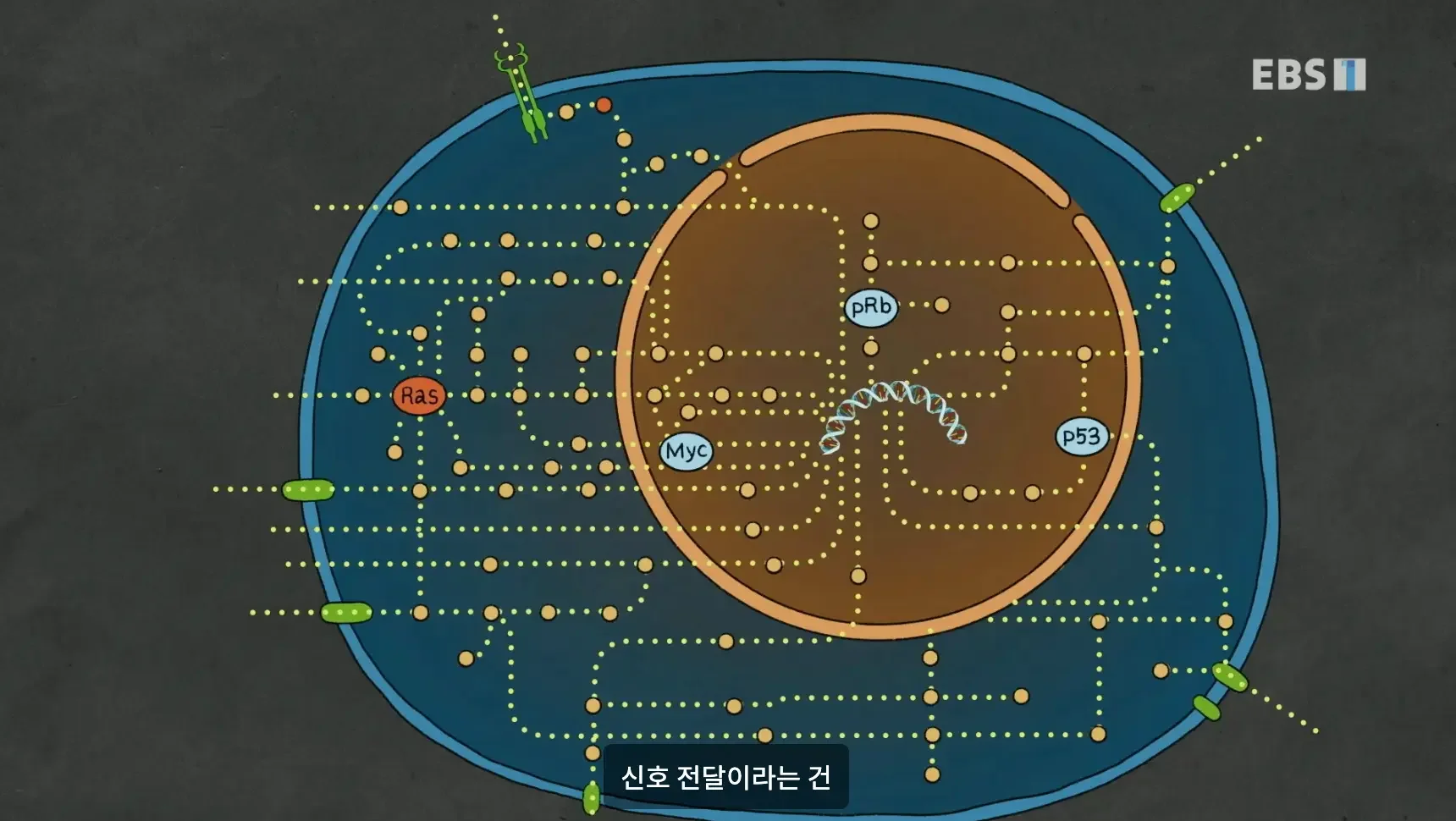
The process of receptors receiving and transmitting signals is very complex. Receptors are extremely complex signal transmission devices. Signal transmission means multiple proteins organized like electrical circuits. This signal transmission device helps analyze signals and decide whether the cell should proliferate. In other words, receptors transmit signals to the cytoplasm.
If the gene that makes receptors is damaged, the receptor's function is also ruined. In other words, DNA mutations create abnormal proteins, and when these abnormal proteins participate in signal transmission, cell proliferation begins even when it shouldn't.
Lecture 2 Summary#
Mutant genes -> The core cause of cancer
DNA genetic information distributed equally through cell division
Cell division -> DNA replication -> Incorrectly replicated base = Mutation
The human body is composed of about 30 trillion cells, human cells are replaced about 300 times in a lifetime, and the total cell divisions in a lifetime number about 10 quadrillion
- The higher the number of cell divisions, the higher the chance of errors during DNA replication, increasing cancer risk
Cancer risk increases through evolution as it grows larger
Different types and densities of mutations cause various types of cancer
DNA contains numerous mutant genes that cause various cancers
DNA mutations trigger unlimited cell proliferation
External invaders that cause mutations:
- UV radiation
- Moldy grains
- Cigarettes
Other factors that cause mutations:
- Cells that received abnormal rulings due to improper gene distribution
- Abnormal chromosomes
Lecture 3: How Does Cancer Proliferate?#
Robert Weinberg, who first discovered cancer genes, reveals the secrets of cancer cells. Normal cells send signals to each other to decide whether to proliferate.
The receptors are what transmit those signals, and if a mutation occurs in these receptors, they proliferate endlessly without receiving a proliferation signal.
We call these infinitely proliferating cells cancer cells.
So if a receptor breaks, does everyone get cancer?
Surprisingly, our bodies have evolved to prevent cells from being transformed — that is, from becoming cancer cells.
In Lecture 3, Robert Weinberg explains specifically how cells can infinitely proliferate while showing evidence of how our bodies have resisted cancer.
We've talked about how mutant genes cause cells to proliferate abnormally, but we haven't looked closely at how cells decide to proliferate abnormally. To do that, we need to look at how cancer progresses.
Many types of cancer cells mistakenly believe they've received a signal from outside telling them to proliferate — even though no such signal was ever sent. As a result, cancer cells proliferate inappropriately and abnormally. This abnormal proliferation is the cause of cancer. It's also the reason cancer grows increasingly abnormally.
So how do normal cells process signals received from outside, and through what process does a cell decide whether to proliferate? And how is that decision actually made?
Receptors on the cell's exterior receive signals from other cells, become activated, and transmit those signals to the cell's interior. This process is called the signal transduction pathway. The signal transduction pathway is the process of handling signals received by receptors. It amplifies or diminishes signals, ultimately sending information to the cell nucleus, which decides whether to proliferate.
Of the 20,000 genes in the human genome, about 50 are involved in cancer development. These genes produce proteins — important regulatory factors that determine tumor cell growth. Most of these genes are called oncogenes (tumor genes). Oncogenes produce proteins that constantly send out proliferation-promoting signals.
There are also genes that contribute to cancer development in a different way. They're called tumor suppressor genes. Tumor suppressor genes don't promote cell proliferation — they actually stop it. These genes tell cells to stop proliferating when proliferation is inappropriate.
Nearly all cancers have both types of mutant genes. Oncogenes become overactivated genes, and tumor suppressor genes become inactivated in tumors. Due to the influence of these two genes, cancer cells proliferate uncontrollably.
Human cells need mutations in at least 5 genes before they start proliferating like cancer cells. These 5 genes represent 5 important circuits in the cell. Therefore, all 5 critical circuits must be broken before a cell can proliferate abnormally. This doesn't happen easily.
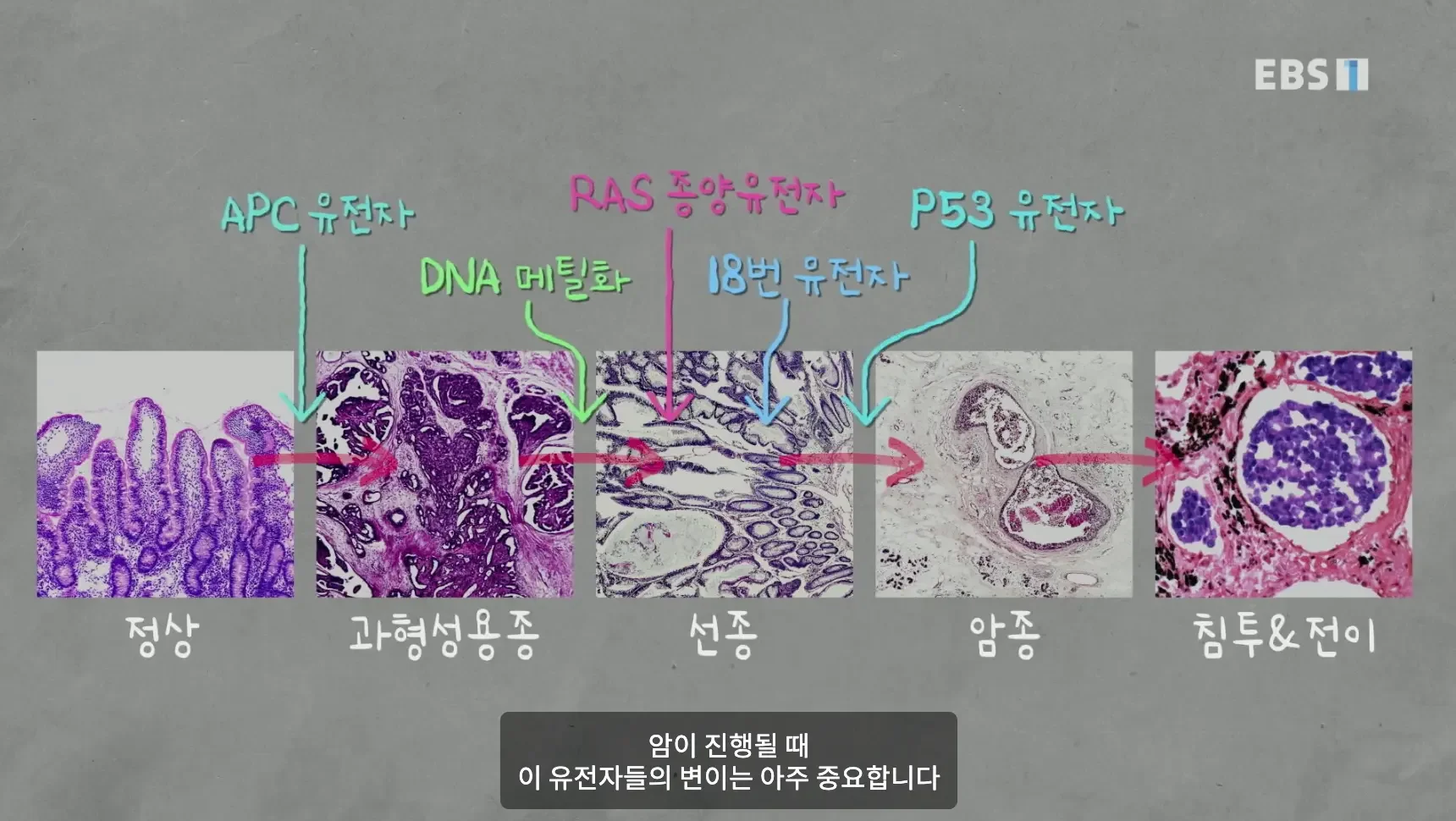
Cancer is called by different names at each stage of formation: normal, hyperplastic polyp, adenoma, carcinoma, invasive metastasis, and more.
Lecture 3 Summary#
Signal transduction pathway
- The process of handling signals received by receptors
- Sends information to the cell nucleus, which decides whether to proliferate
Abnormal cell proliferation caused by mutant genes
-> Cancer cells = Mistakenly believe they've received a proliferation signal from outside
-> Continuously proliferating signals from protein changes caused by mutations break cell behavior
About 50 of the total 20,000 genome genes are involved in cancer development
Cancer occurs through the conspiracy of overactivated oncogenes and inactivated tumor suppressor genes
Infinite proliferation of cancer cells; minimum 5 mutant genes needed for cancer cell proliferation
Oncogenes
- Constantly promote cell proliferation
- Proteins made by about 50 genes that determine cancer cell growth
RAS gene
- An oncogene that makes proteins send out abnormal proliferation-promoting signals
Tumor suppressor genes
- Suppress cell proliferation
Lecture 4: How Does Metastasis Progress?#
Robert Weinberg, who first discovered cancer genes, reveals the secrets of cancer cells. When a tumor forms in the body, why and how does it become dangerous?
A tumor is hardly threatening while it stays in place, but once metastasis begins, the story changes.
The secondary tumor from metastasis creates entirely new mutations that threaten life.
Over 90% of cancer deaths are caused by metastasis.
Lecture 4 explains what stages a tumor goes through to metastasize and what the important characteristics of metastasis are.
Regarding metastasized cancer with its high mortality rate, Robert Weinberg brings up the biggest challenge in metastasis research.
Can we humans overcome this problem?
Once a tumor forms, why and how does it become dangerous? The tumor created through cancer progression spreads throughout the body and threatens the cancer patient's life.
When we talk about cancer spreading, we use the term metastasis. Metastasis means primary tumor cells leave their original location and spread to distant body parts. These tumors then proliferate in other areas and form new secondary tumors. Once a tumor has grown sufficiently, primary tumor cells begin invading nearby tissues. Then they spread to distant tissues through the body's circulatory system. Metastasis specifically means spreading to distant locations, not just nearby tissues.
When primary cancer cells invade nearby tissues, they utilize the wound healing program that normally operates. They use the existing wound healing program as-is. When cancer cells gain invasive ability, they inadvertently enter the circulatory system, and consequently, primary tumor cancer cells infiltrate blood vessels. Once primary cancer cells infiltrate blood vessels, they can travel to distant parts of the body. This is blood-mediated metastasis — blood carrying cells to distant tissues.
Cancer cells can be attacked or eliminated while traveling through the bloodstream. And forming colonies in distant tissues — an unfamiliar environment for cancer cells — is even more difficult. So even when cancer cells arrive at distant tissues, they can't adapt well to the environment and can't successfully proliferate. This is why metastasis is hard to achieve. Yet over 90% of cancer deaths are caused by metastasis. This fact alone provides sufficient reason to study metastasis in depth.
Lecture 4 Summary#
Primary tumor
- The first tumor that forms at the site where cancer started
- Sufficiently treatable with surgery
- Not threatening by itself
Metastasis
- Cancer cells spreading from their origin to other body parts
- Cancer cell movement = Invasion of nearby tissue -> Spread to distant tissue
Secondary tumor
- Forms an entirely different secondary tumor at the new location
- More evolved secondary tumors threaten life
Types of tumors and cancer cells
- Primary tumor
- Metastasizes through blood
- Moves to nearby tissues through lymph nodes
- Progresses in successive stages. Life is threatened by metastasis, not the primary tumor
- Invasive tumor
- Invades adjacent areas
- Cancer cells
- Cancer cells that exploit normal cells' existing programs
- Cancer cells that use wound healing programs to invade nearby tissues
- Cancer cells that infiltrate blood vessels
Metastasis process
- Cancer cells invade nearby tissues
- Cancer cells infiltrate blood vessels
- Settle in distant tissues
- Cancer cells proliferate to form metastatic colonies
Inefficiency of metastasis
- Only about one in a million primary tumor cells manages to form a metastatic colony
- Even if cancer cells spread throughout the body, finding a suitable environment for metastasis is difficult
- Our body tissues are an inhospitable environment for cancer cell growth
Why metastasis rarely succeeds
- Cancer cells are easily eliminated while traveling through blood
- New environments are difficult for adaptation and proliferation
- Cancer cells are easily eliminated while traveling through blood
Lecture 5: How Can We Treat It?#
Robert Weinberg, who first discovered cancer genes, reveals the secrets of cancer cells. As medical technology has advanced, cancer treatments have also evolved.
But cancer still accounts for 20% of deaths in modern society. Cancer remains an object of fear.
To address this problem, Robert Weinberg, who has studied cancer for 50 years, focuses on the principles of cancer development.
Lecture 5 introduces treatments that apply the principles of cancer development and presents the direction that cancer treatment should take going forward.
In this lecture, Robert Weinberg emphasizes that there's something just as important as treatment, and examines what cancer means for us by looking at various cancer statistics.
The question of how to treat cancer is really interesting. But an even more important question is how we can reduce the number of people who die from cancer each year. Considering that 20% of all deaths worldwide are caused by cancer, this is an important goal for us.
For some cancers, mortality rates have actually decreased. Over the past 60 years, cancer mortality rates in the US have dropped dramatically. Stomach cancer, colon cancer, and cervical cancer all showed major decreases. We can think about what causes cancer and how to prevent it. What's behind the dramatic drop in cancer mortality?
For stomach cancer, it's because we can now store food more hygienically, which reduced toxic mold. Also, our ability to eliminate bacteria in the stomach — a major cause of stomach cancer — has improved.
Cervical cancer deaths decreased significantly thanks to the development of the Pap test, which examines women's cervixes. It became possible to detect cervical cancer early, before it developed into something fatal.
Colon cancer (including rectal cancer) saw mortality decrease through the diagnostic method called colonoscopy.
However, lung cancer mortality remains high. The cause of lung cancer is abundantly clear — most lung cancer deaths are caused by smoking. As people smoked more, lung cancer mortality increased. When people quit smoking, mortality decreased. The drop in lung cancer mortality was because lung cancer incidence itself decreased. 90% of lung cancer patients are directly affected by smoking.
Pancreatic cancer and ovarian cancer remain deadly. These two cancers are discovered at late stages, so unfortunately most people diagnosed with them will die.
For some cancers, our current treatment methods have limitations and aren't effective. What's the lesson from this entire lecture series? It's that preventing cancer is far more effective than treating it after it develops. The dramatic drop in lung cancer mortality wasn't because lung cancer treatments improved — it was because smoking rates decreased.
The lesson here is crystal clear. An important way to reduce mortality is to change lifestyles to prevent cancer from developing in the first place.
Statistics show that cancer incidence rates differ by country, which tells us that diet, lifestyle, and environment are important factors in determining whether cancer develops. If we can reduce cancer incidence, we don't need to worry about treatment — because preventing cancer from developing in the first place is far more effective than treatment. Over 70% of cancers in the US could be prevented through lifestyle changes.
Cancer is a disease of aging. As people's lifespans have gotten longer, cancer incidence has increased. This isn't because the probability of getting cancer increased, but because humans are now living long enough for cancer to manifest. In the past, people died from other diseases before reaching old age. Now that we live longer, sadly the probability of getting cancer has increased proportionally.
Lecture 5 Summary#
Causes of decreased cancer mortality:
- Hygienic food storage
- Improved ability to eliminate bacteria
Cervical cancer mortality decrease -> Development of Pap Test
Colon cancer mortality decrease -> Development of colonoscopy
Lung cancer mortality decrease -> Decreased smoking population -> Decreased lung cancer incidence
Breast cancer mortality decrease -> Development of targeted therapy, hormone therapy, etc.
Effective treatments are in development, but limitations still exist. Especially pancreatic and ovarian cancers remain nearly impossible to treat.
Preventing cancer is far more effective than treating it. Changing lifestyles to prevent cancer is crucial.
Understanding the causes of cancer is key for prevention.
Causes of cancer:
- Workplace exposure to hazardous substances
- Smoking (25+ cigarettes per day = 27x higher risk of lung cancer)
- Diet (eating too few vegetables, high-salt foods, fried or directly grilled foods, foods high in nitrates)
Over 70% of cancers can be prevented through lifestyle changes alone!
New cancer treatment: Gleevec
- A chronic myeloid leukemia treatment that suppresses white blood cell proliferation
- Blocks signals sent by abnormal proteins
- Reduces cancer risk by regulating cancer-related protein functions
Why cancer keeps persisting:
- Cancer is a disease of aging
- Increasing elderly population
- Cancer incidence rises as lifespans increase
Challenges for overcoming cancer:
- If cancer is a problem of aging, it's a problem that won't disappear
- Pancreatic and ovarian cancer causes remain unsolved
- Identifying cancer causes and researching treatments is the next generation's homework
Wise men talk because they have something to say; fools, because they have to say something.
— Plato