
Watch the Lectures#
Richard Nisbett - How Does Thinking Work?
- Lecture 1 East vs. West: Differences in Perception
- Lecture 2 East vs. West: Who Is Right?
- Lecture 3 The Ruler of Consciousness: The Unconscious
- Lecture 4 The Unconscious: Primal Abilities
- Lecture 5 Intelligence: Nature or Nurture?
Lecture 1: East vs. West — Differences in Perception#
East and West have different ways of thinking. We can divide them into East and West, or more specifically, East Asia and Western Europe. Easterners place much greater weight on context than Westerners. Westerners tend to focus on the object rather than the context. The object could be a person you want to influence or someone's behavior you want to understand.
East Asian reasoning and perception are based on a holistic perspective. They tend to analyze by focusing on the various attributes of an object and the diverse rules governing its behavior. That's why East Asians are described as situation-centric. They react sensitively to their environment. In the East, what matters is getting along well with people around you and harmonizing your behavior with the situation. In contrast, Americans are individual-centric. They want the environment to adapt to them. They want to control their environment. Compared to Easterners, it's not that difficult for Americans to sever social relationships.
In the West, the self is really important. In the East, people see their self as part of the whole. If a friend moves away or dies and can't be seen anymore, they say they feel like a different person. In America, people think that's strange. Even if I (= Richard) lose a dear friend, I won't change. Because my relatively stable inherent traits remain the same.
Eastern perception and reasoning tend to be holistic. The East considers the entire context and the relationship between each context and the individual or object. The West, on the other hand, tends to be analytical, focusing on the important object for analysis. That's why the information they perceive is very different.
Lecture 1 Summary#
| Comparison | Social Differences | Cognitive Differences | |
|---|---|---|---|
| East | - Reads context (context > object), relationships and similarities- Situation-centric, reacts sensitively to surrounding environment- Analyzes multiple attributes and rules of objects together- Harmony with environment matters more than individuality | - Holistic reasoning- Considers the full relationship between context, individual, and object- Describes the entire background before notable objects | |
| West | - Focuses on objects (context < object)- Rules and categories- Individual-centric, adjusts and controls environment- Relatively easy to sever relationships | - Object-centric analysis- Thinks centered around the target object |
Lecture 2: East vs. West — Who Is Right?#
In Lecture 2, I want to discuss formal logic. Formal logic is a concept that originated in the West, though it's not widely known. Formal logic started because Aristotle was fed up with the terrible arguments happening in markets and political assemblies. One of the types Aristotle described was the syllogism, which consists of premises and a conclusion. If the premise is "All A are B, and C is A," then you reach the conclusion that C is B.
Formal logic developed over hundreds of years after Aristotle. Meanwhile, in the East, including China, formal logic wasn't considered important. Logic was a topic only Chinese thinkers of the 5th century BCE cared about, and it was quickly forgotten.
At the foundation of Western thought, there's something even more fundamental than formal logic: the concept that "A is A." A is simply A, not something else. "A and not-A" cannot both be true at the same time. Eastern thinking was completely different from the West. They were clearly aware of what Western thinkers call dialectics. The principles of dialectics include the principle of change, the principle of contradiction, and the principle of relationship.
Principle of Change: Reality is constantly changing. What's true now may soon become false.
Principle of Contradiction: Because of endless change, contradictions always arise. Contradiction is the dynamism that underlies change.
Principle of Relationship (or Holism): The whole is greater than the sum of its parts, and parts only have meaning in relation to the whole.
In the Eastern philosophy of Taoism, this can be explained through the principle of yin and yang. Within yin and yang, they oppose or contradict each other, and sometimes transform into each other. This way of thinking is very foreign to Westerners.
The biggest difference between Eastern and Western thinking is the belief in change versus stability — the belief in what doesn't change.
There are traditional differences between Eastern and Western medicine. Surgery didn't exist in the East. In the Eastern mindset, the idea of making someone healthy by cutting something out was considered absurd. In Eastern thinking, balance and harmony within the body were what mattered.
Law also differs between East and West. When sentencing a criminal in the East, there's a tendency to look at the context surrounding the crime and the individual's background. In Western courts, the focus is solely on the type of action and the applicable rules.
You might be wondering which is better — analytical thinking or holistic thinking. After discussing it with Professor Choi In-cheol, analytical thinking is good for science since it requires focusing on categories and rules. In other areas, I've come to think holistic thinking is better.
Lecture 2 Summary#
Eastern Logic
Dialectics -> Can be explained through Taoism's yin and yang; contradiction, opposition, and change are natural phenomena
- Principle of Change: "What's true now may become false later"
- Principle of Contradiction: "Change breeds contradiction, which breeds more change"
- Principle of Relationship: "The whole is greater than the sum of its parts, and parts derive meaning within the whole"
Western Logic
- Formal logic -> The study of the formal structure of correct arguments
- Developed over 100 years after Aristotle (e.g., syllogism)
Difference between Eastern vs. Western thinking -> Related to ecological characteristics including economic and cultural traits
Eastern logic: Context-centric, holistic thinking -> Difficult to teach
Western logic: Object-centric, analytical thinking -> Easy to teach
Lecture 3: The Ruler of Consciousness — The Unconscious#
I want to talk about the way we reason about the world.
Two kinds of minds coexist in our heads. These two are consciousness and the unconscious. Consciousness is a part of the phenomena that occur as we think or act and wonder why we think and act the way we do. We can only explain what happens within our consciousness. Unconscious processes are always running, influencing our thoughts and actions, but we don't know much about the unconscious. Because of this difference between consciousness and the unconscious, distorted and inaccurate views of the cognitive processes underlying our behavior emerge.
We experience cognitive dissonance when we express opinions that contradict our beliefs or when we act in ways inconsistent with how we usually think.
Without realizing it, we learn an enormous amount unconsciously. We don't even know that we already know things we've learned. There's a rule known as the dumb jock strategy. Everyone follows the same rules but doesn't know they're doing it.
Even when solving the most complex problems, we're greatly influenced by the unconscious. Some problems require consciously using rules to solve them. Experts solve problems using both conscious and unconscious thinking simultaneously.
Experiments continued showing that people perform certain actions but don't know the exact reasons. And when told the real cause of their behavior, people get confused and deny it.
People can be clearly wrong about cause and effect. They think the cause is the effect and the effect is the cause. There's also the halo effect. If you like someone, you like everything about them; if you dislike someone, you dislike everything. In reality, you like someone's traits because you like them as a person, but people think they like the person because of their traits.
We don't consciously access our cognitive processes. Even when we recognize that a lot happened in our heads while solving a problem, we can't examine those cognitive processes. Even if we know exactly how to solve a problem, that doesn't mean we've examined how consciousness works.
We don't know how cognitive processes work. For example, people can gauge distance by seeing parallel lines converge in the distance. But we're not aware of this. We don't know we're doing it.
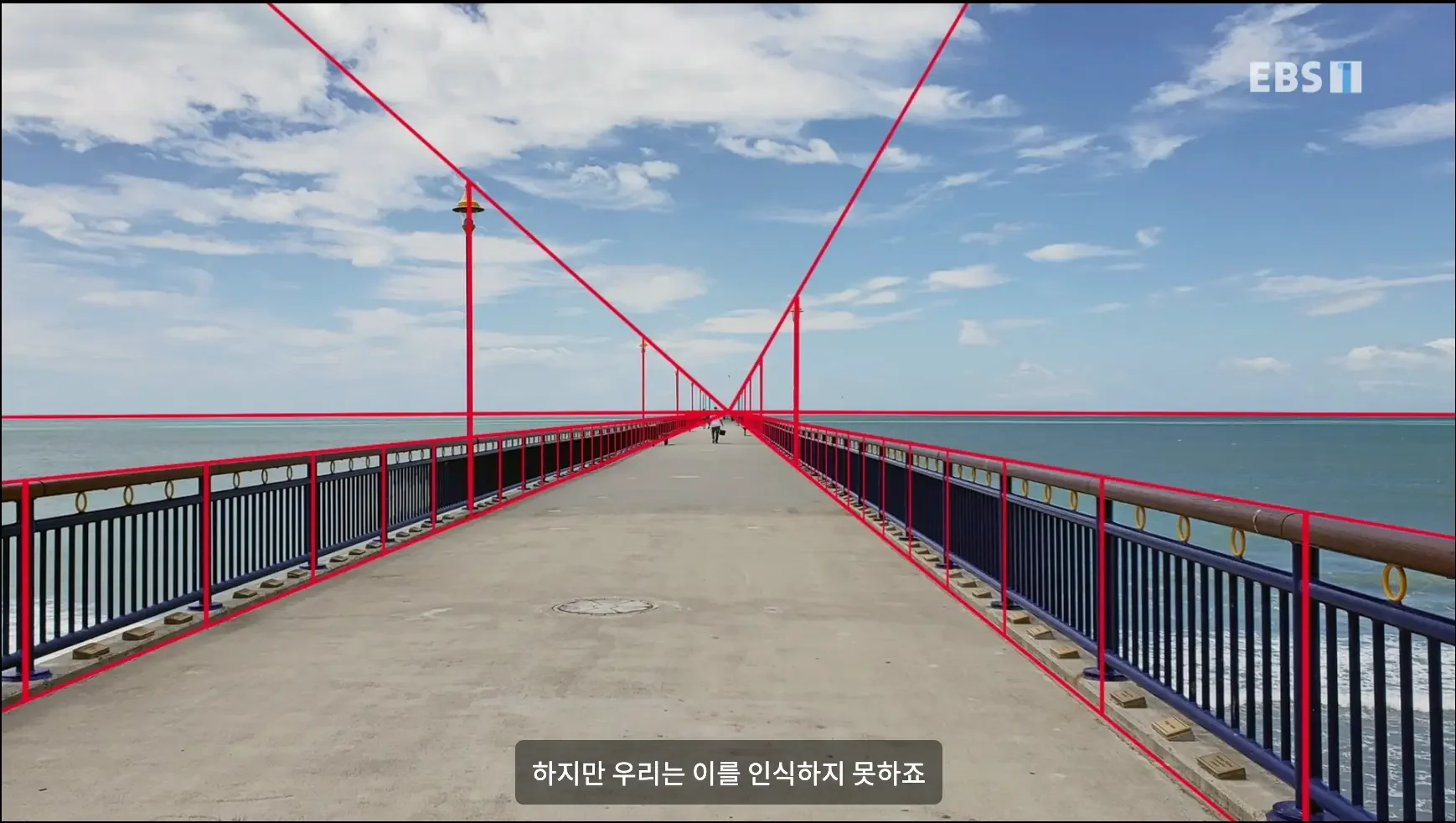
The lesson from all these experiments is that the things in our heads have enormous influence, and usually we're unaware of our own behavioral and decision-making processes.
Lecture 3 Summary#
Consciousness: The part we can recognize
Unconscious: Always influences thoughts and actions but cannot be recognized
Distortion of cognitive processes arises from the difference between consciousness and the unconscious (cognitive dissonance)
- We don't consciously access cognitive processes. It's difficult to consider cognitive processes when solving problems
- We unconsciously use acquired rules. The unconscious unknowingly has a major impact on behavior and judgment
- The unconscious can solve even complex problems. Rules can be utilized unconsciously
(e.g., dumb jock strategy, halo effect, causal reasoning errors)
Lecture 4: The Unconscious — Primal Abilities#
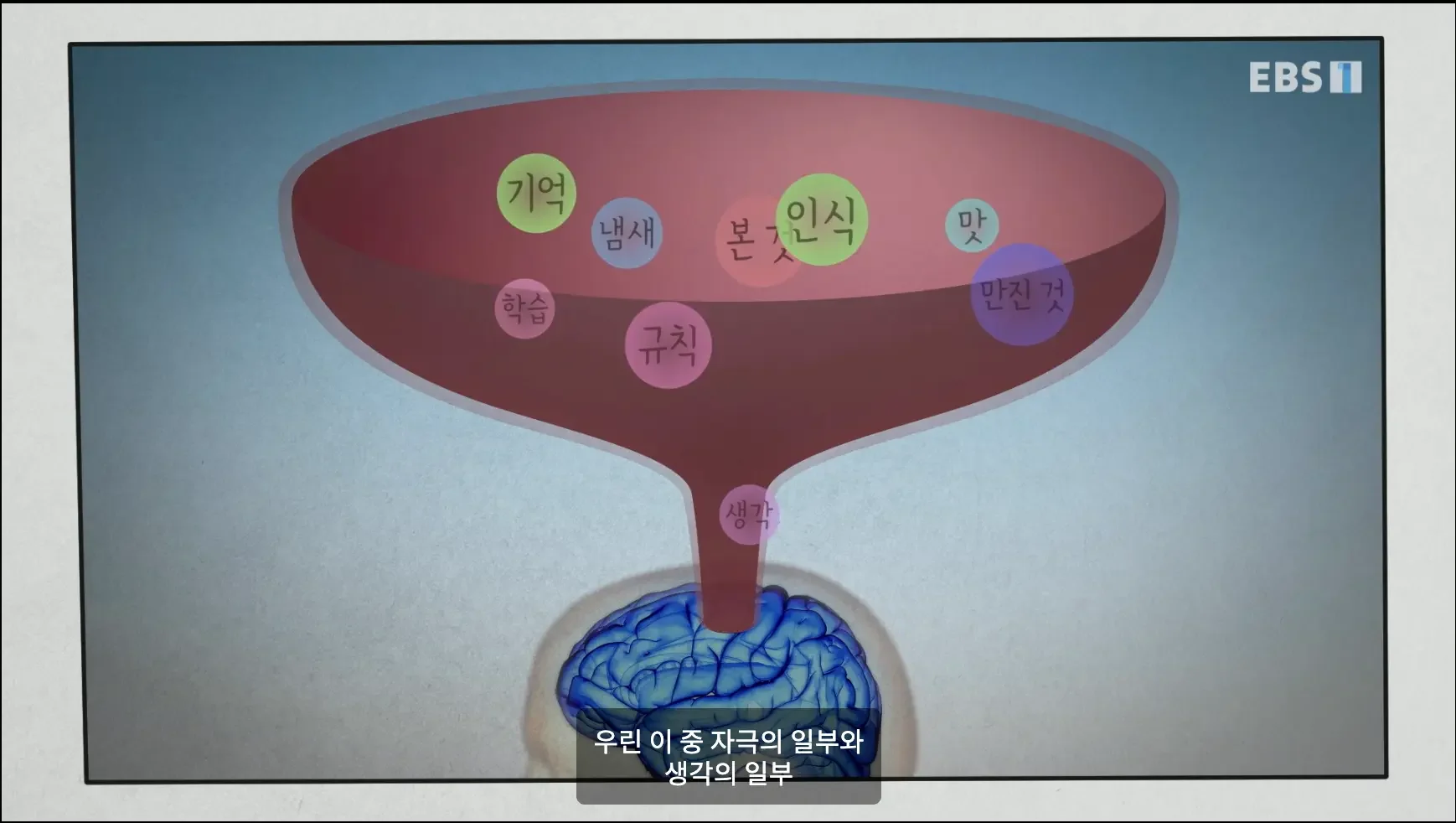
Imagine your mind is like a funnel. An enormous amount of activity happens at the top of the funnel.
We only perceive a fraction of the stimuli, a fraction of our thoughts, a fraction of what we notice or don't notice, and some of the rules that govern our thoughts. We're aware of them but don't know they're influencing us.
The sentences judges give to convicted criminals vary depending on what time the trial takes place. Before lunch, judges are probably hungry. That makes them a bit uncomfortable. Before lunch, they give longer sentences, and after a satisfying meal, they give shorter ones. Baby-faced people are more likely to receive lighter punishments when convicted of crimes. People with soft, smiling faces get lighter sentences. If you want someone to like you, put a warm coffee in their hands. They'll think you're a warm person. No cold iced tea. Absolutely not. It gives a cold impression.
Showing a smiling face is also good. 0.001 seconds is so quick that you can't consciously register a smile, but if you catch even a fleeting glimpse of a smiling face, you're much more likely to end up liking that person.
When talking to someone, try mirroring their body language. If they cross their arms, you cross yours. If they rest their chin on their hand, you do the same. The conversation flows better and you gain their liking. If you don't mirror them — say they rest their chin and you lower your arms — instead of intimacy, the atmosphere gets awkward and it's hard to gain their favor. It doesn't feel enjoyable to be together.
In familiar situations, you can accurately explain the reasons for your behavior. But in new situations, it's different.
- In new situations, you can't predict how you'll behave.
- After acting in a new situation, you're more likely to misattribute the cause of your behavior.
Since you can't know the cognitive process behind your actions, if you do something unexpected, you make up reasons. You create stories to explain your behavior or beliefs. The creative process is especially likely to be unconscious.
Sometimes it's better to let the unconscious solve a problem rather than trying to solve it consciously. If you have an important decision to make — like which school to choose or which house to buy — it's good to consciously focus on the choices. Make a list. Create a list of things like the price, the overall atmosphere, the structure of the product, assign values, and think carefully. But don't decide as soon as you finish the list — sleep on it, then decide.
If you don't give your unconscious time to work on a choice, you might end up making a wrong decision.
Know that the unconscious does remarkable work for us. But you have to consciously prepare the unconscious. Think consciously about what the problem is. Think of a few useful directions for solving the problem. Then the unconscious will get busy working for you.
- If you know there's a possibility the unconscious could lead you astray, you can become more careful. Having a bit of hesitation and uncertainty is probably good, especially in special situations you've never experienced before, where there are no rules for how to act.
- When others tell you the reasons for their behavior or thoughts, you can receive them with some skepticism.
As such, unconscious forces operate in ways we don't perceive. They influence our choices and actions more than we think, and understanding this is important.
Remember that the unconscious needs to be stimulated for it to work.
Lecture 4 Summary#
The unconscious operates automatically in many cases and can be used intentionally.
Creative outcomes come from the unconscious.
The unconscious can solve problems that consciousness cannot.
Without time for the unconscious to work, we make poor choices.
Knowing how the unconscious works makes us more careful in our thoughts and actions.
Lecture 5: Intelligence — Nature or Nurture?#
For about 70 years after World War II, Western psychologists understood intelligence as simply a genetic matter. They believed IQ — the measure of intelligence — varies among people, with 60-80% of that variation determined by genetics. They thought childhood experiences, what family you grew up with, or whether you went to school didn't matter. Basically, they believed humans are born with a genetically predetermined IQ.
They also claimed that human intelligence had declined over several generations. Since the wealthy in rich countries have fewer children than the poor, they argued overall intelligence was steadily declining. They said Black people's IQ scores are about 15 points lower than White people's, partly due to genetics. There were also claims that East Asians' higher IQ compared to Westerners was genetic.
But all of this is wrong. The logic that IQ is determined by genetics is highly misleading. They argued that even identical twins raised in different environments showed high IQ similarity, therefore environment doesn't matter. But the IQ similarity of identical twins raised in very different environments is clearly lower.
Childhood home environment is extremely important. There's a test that evaluates the home environment — it observes whether there are books in the house, whether pencils are lying around, how the family communicates. It looks at whether parents converse with their children as equals or just give orders. This score, called the HOME score, is closely related to a child's IQ as an adult. Comparing families with average HOME scores to those at the 68th percentile, the IQ difference is 9 points.
School also has a major impact on intelligence. You can't become smart without school. There's an excellent observational study underway in the US — a child born on August 31st can enter first grade, but a child born just one day later on September 1st cannot. When you compare the IQs of these two children at the end of the year, the child who attended school had a significantly higher IQ.
Over the past 70 years, people in wealthy countries have seen IQ increase by 18 points. An 18-point IQ difference is comparable to the difference between someone with only a high school education and someone with a graduate education. IQ increased because reading and arithmetic skills became necessary after the Industrial Revolution.
Reading and writing develop the ability to think logically and understand things like the nature of categories. We can barely imagine how uneducated people think. It's almost impossible to understand.
In the information age, people need analytical thinking about information and sometimes need to be able to think mathematically.
Complex computer games with various missions also affect intelligence.
In studies comparing the cognitive abilities of East Asians and Americans, Asian Americans were overall more likely to become professional and technical managers than European Americans. This isn't due to genes but cultural differences. In the East, education is highly valued, and parents place great importance on their children's grades.
Lecture 5 Summary#
Misconception about intelligence: "Intelligence (IQ) is genetic"
- Home environment and relationship with parents affect intelligence
- Logical thinking is formed during elementary education
Misconceptions about the influence of genetics vs. environment
- Genetic test results show no relationship between genes and intelligence scores
- The intelligence gap between Black and White people is not genetic but environmental
Differences in Eastern vs. Western approaches to education
- The cognitive ability gap between Europeans and Asians is clearly significant but unrelated to genetics
- Due to cultural differences including Confucianism
Reasons IQ has risen
- Industrial Revolution: Improved reading and arithmetic skills needed for work
- Information Revolution: Analytical and mathematical thinking required, leading to the need for more schools
The greater part of human pain is unnecessary. It is self-created as long as the unobserved mind runs your life.
— Eckhart Tolle