
Watch the Lectures#
Dan Ariely - The Psychology of Money
- Lecture 1 The Trap of Money
- Lecture 2 The Price of Emotions
- Lecture 3 The Pain of Paying
- Lecture 4 The Value of Relationships
- Lecture 5 The Secret of Motivation
Lecture 1: The Trap of Money#
We all have moments in life where we think we should have acted differently in the past.
Whatever we do, there's always a big gap between who we are and who we want to be.
Behavioral economics studies this gap — and how to close it.

What is money? What is the psychology of money?
Without money, when exchanging apples for broccoli, how much broccoli should one apple be worth?
With money, who decides why an apple costs a different amount than broccoli?
Money is an incredible technology. Without money, we couldn't save, couldn't have jobs, and couldn't make plans.
The true essence of money is something else entirely — it's opportunity cost. When we spend money, we must always think about opportunity cost. When you buy something, you have to give up something else.
Have you ever thought about opportunity cost when buying a cup of coffee? Do you think, "If I don't buy this coffee now, what else could I do with this money?" Most people don't think about opportunity cost when making a purchase. Even when buying something expensive, they don't think that way.
"If you buy this car today, what would you have to give up?" When asked this question, people usually can't answer easily — they've never thought about it. The answer might be several years of summer vacations, 70 cups of coffee, and 16 books.
Two major mistakes we make with money are relativity and fairness. People view money in relative terms.
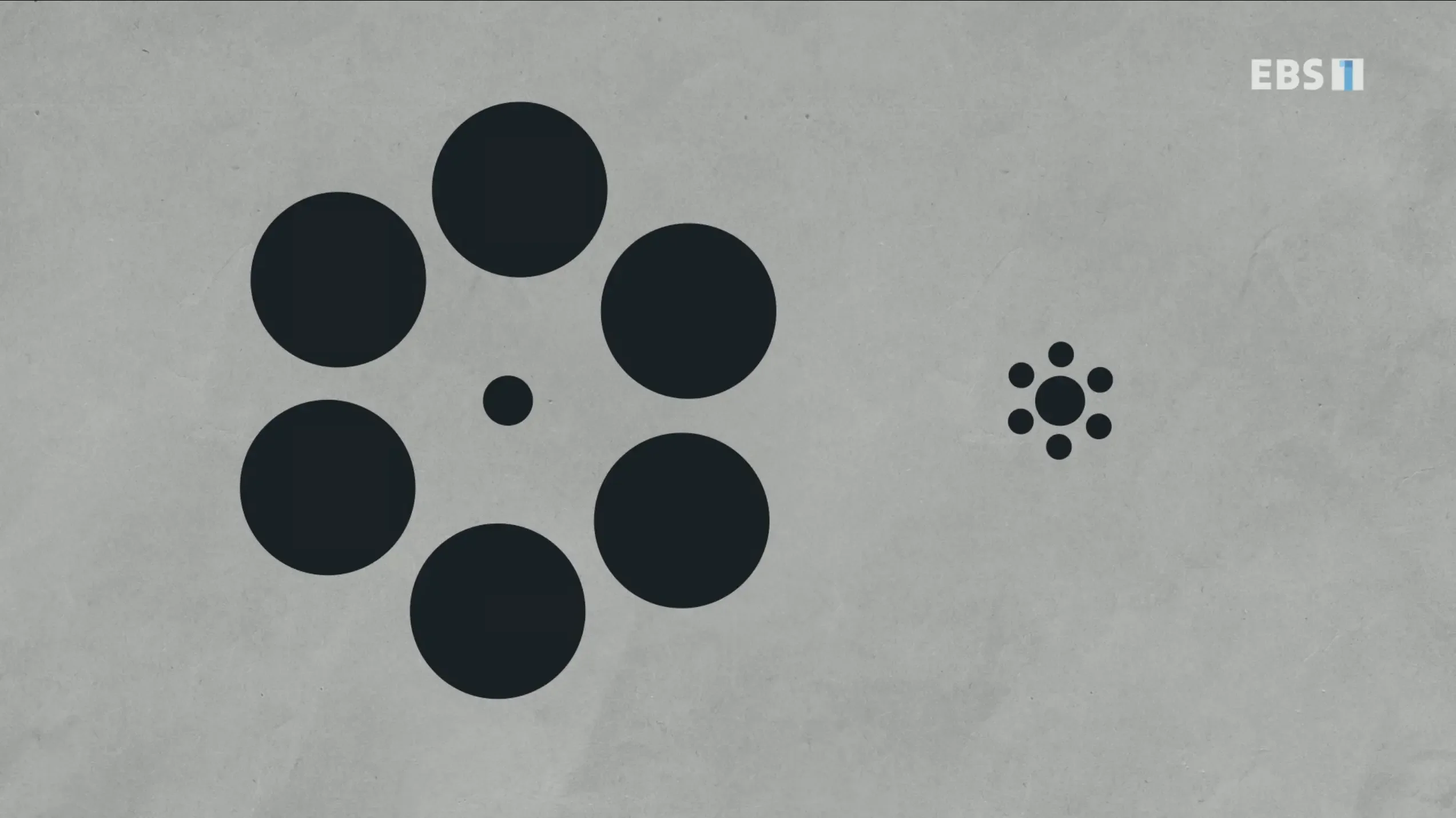
The easy way to distinguish an optical illusion is to erase the background. You think you're comparing the two inner circles, but you're actually comparing the surrounding environments. People apply this same perspective to money.
Relativity doesn't always lead to the right decision, so it's better to compare in absolute terms. So question relativity.
Another mistake is fairness. People evaluate fairness. It's hard for ordinary people to assess the quality of work. So they say the more effort that goes in, the more it's worth paying for.
Related anecdote: Picasso was sitting in a garden when a woman approached and asked him to draw her portrait. Picasso drew it and handed it over. The woman was amazed at how much it looked like her and asked how much she owed. Picasso said 500 for 30 seconds of work, and Picasso replied, "You shouldn't see it that way. It's 30 seconds built on 30 years."
When evaluating something, we don't just evaluate the end result. We try to evaluate how much effort went into producing that result.
Can money buy happiness?
- People who buy things for themselves find that happiness fades quickly
- People who buy things for others find that happiness doesn't stay the same but lasts longer
To avoid mistakes with money, we should be wary of relativity. We should abandon the habit of evaluating based on effort rather than usefulness or value.
Lecture 1 Summary#
Behavioral economics: Studying how to close the gap between who we are and who we want to be
Psychology of money: Studying irrational behavior and thinking related to money
The essence of money: Opportunity cost (what you have to give up instead)
Mistakes with money:
- The relativity trap: Evaluating money from a relative perspective
- The fairness trap: Evaluating effort and process that went into the result
Lecture 2: The Price of Emotions#
Money is cognitive and rational. We handle money-related matters carefully, but emotions influence many of our financial decisions.

Time preference: When outcomes are far in the future, we make rational decisions, but as they get closer to the present, we're more influenced by emotions. The closer a problem gets, the more emotional we become. If a decision pulls strongly on our emotional strings, we get pulled in that direction.
Emotions influence financial decisions, and this is called the free effect. People sometimes pay a larger amount for the privilege of getting something for free.
The endowment effect: We judge the value of everything from our own perspective. If we own something, we consider it to be of great value; if we don't own it, money feels more important. The endowment effect includes the IKEA effect. Things we make ourselves come with greater attachment, so we assign them higher value than what outsiders would assess. The longer it takes, the more we like it. So others might not appreciate its true worth, or we might be the ones out of touch with reality. For the maker, certain parts feel special and good. Other people might see the finished product as a mess. Others don't like it as much.
Lecture 2 Summary#
Money is perceivable and rational, but emotions influence decisions about money
Emotions affect money decisions in various ways
3 effects of emotions on decisions:
- Time preference: The closer to the present, the more emotional the decision
- Free effect: Forgetting losses for the charm of "free"
- Endowment (IKEA) effect: Judging value from your own perspective
Lecture 3: The Pain of Paying#
People feel much worse paying with cash than with a card when settling a meal.
How about this example? During a meal, you're charged 50 cents per spoonful, and someone records every bite you take. Financially, it might be a good deal, but can you enjoy the meal? Everyone would try to take huge bites and not really enjoy it. When you have to pay per bite, you're too focused on the money. So enjoyment decreases a little with each bite.

When users switch their payment method to automatic debit, electricity consumption increases by 4%. When you see the electricity bill and check the amount, you tell family members to reduce usage next month. But with automatic payments, you stop paying attention to the electricity bill.
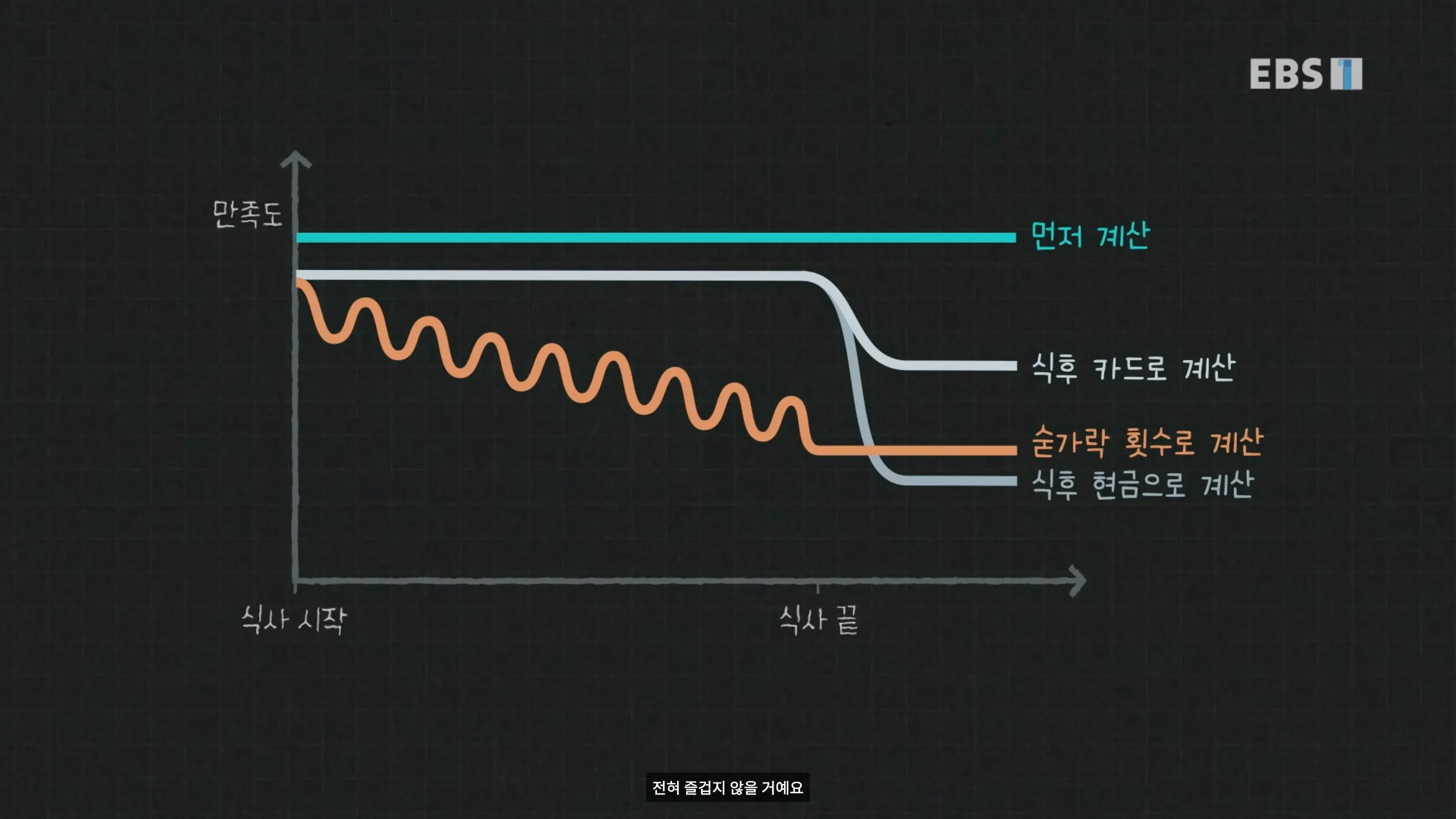
Paying attention to spending reduces enjoyment. Another aspect of attention is operational transparency. When doing a Google search, seeing progress indicators during the brief loading time as results are placed and delivered provides greater satisfaction than seeing everything appear all at once. If you add operational transparency by providing information about progress, people evaluate the work as more valuable and are willing to pay more.
We're all inside our own transparency bubble — we see every detail of our own work but not others' actions. People tend to exaggerate what they've done and undervalue what others have done, so it's good to have operational transparency in relationships. You should tell the people around you what you've done. You need to make the invisible visible. When we learn that someone worked hard for us, we happily pay the price.
Lecture 3 Summary#
The pain of paying -> When spending and consuming happen simultaneously, enjoyment decreases
Advantage of payment pain -> Functions to reduce harmful consumption like cigarettes
When prioritizing life's enjoyment -> Payment pain can be avoided
Operational transparency issue:
- Invisible processes are undervalued
- Visualizing loans, insurance premiums, savings, etc. provides positive motivation
- Interest in payment method, not money itself
- Visible effort positively impacts evaluation
Lecture 4: The Value of Relationships#
Does it feel negative to mention money in certain situations? The reason is that mentioning money changes the nature of the relationship.
When someone helps you in a difficult situation and you offer a small amount of money, if the amount is small, it can change how they feel and removes the joy of helping others.
If a family member serves a lavish home-cooked meal and you give money or a gift in return, you've put a price tag on family love. It can demean social relationships.

Social norms influence people's behavior. We behave in certain ways because we love others and belong to a society. When money enters the picture, social norms disappear.
Social motivation and financial motivation are different. These two don't mix well in the two worlds of social norms and market rules — like oil and water. You have to choose one. Social norms have many advantages. The more you follow social norms, the more progress you make and the more you benefit from social relationships. They also give you a long-term perspective. Praise puts the giver and receiver in the same domain.
Lecture 4 Summary#
Money entering social relationships -> Turning social relationships into market rules
Social motivation and financial motivation are different
Social relationships are more important than money
Following social norms leads to benefits from relationships
Social norms vs. market rules:
- Split the bill equally.
- Each person pays for what they ate.
Lecture 5: The Secret of Motivation#
Marathon runners don't look happy. Nobody smiles while running a marathon. Marathon seems completely unrelated to human motivation.
We move for various reasons beyond momentary pleasure. Motivation comes from many factors including a sense of achievement, overcoming difficulty, and teamwork.

Motivation at work or school is mostly connected to enjoyment. When you truly enjoy something and give it your all, you can gain something valuable. How to find genuine interest is what really matters. It can come from love or teamwork, and it arises from overcoming difficulties.
Motivation is related to our inner selves. But people think things like bonuses provide motivation. Even with tremendous enthusiasm, you can still fail. Methods for motivation include teamwork, pride, and a sense of achievement. The more bonuses there are, the more stress increases and performance decreases.
When we think about money and motivation, we should consider who is actually affected by lacking money. Money is a basic means. Bonuses aren't a cure-all. We need to understand what influences people and figure out who money can actually help. People have many motivations.
Research shows that employees feeling respected has an enormous impact on company success. When employees feel they won't be punished for mistakes, company performance improves. Companies want employees to try, experiment, and produce results. When things fail, they shouldn't blame employees. Feeling like you're working toward the same goal together is a huge factor in success.
Making a company a great place to work makes employees happy, and managers and shareholders happy too. Motivate people properly and encourage them. Money helps, but it also frequently hurts. If you think about motivation and invest in it, everyone can thrive.
Lecture 5 Summary#
Motivation is largely related to our inner selves (however, enthusiasm alone doesn't always lead to success)
Methods for motivation -> Teamwork, pride, sense of achievement
The key to bonuses -> Who is affected by money
Money is merely a basic means of motivation
- Promote top performers and raise base salary instead of bonuses
- Give bonuses only to employees who can be positively influenced
Money -> How much to give, how to give it, who to give it to
Proper motivation is the way to get free energy -> Employees and company aligned toward the same goal
- Money as a motivator is ineffective and expensive
- Fairness of salary is important -> Major impact on employee emotions and company success
But I'll tell you what hermits realize. If you go off into a far, far forest and get very quiet, you'll come to understand that you're connected with everything.
— Alan Watts