
Amazon isn't just a massive corporation -- it's a company that has built a system of repeatable innovation.
At the core of it all are very clear principles about 'How Amazon Works.'
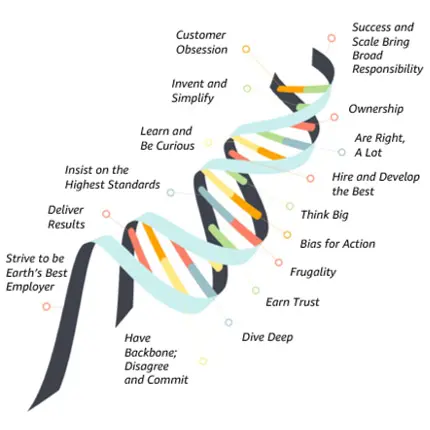
Leadership Principles: The DNA That Drives Culture#
Every action at Amazon starts from the customer obsession principle.
Team direction, data, and development priorities are all evaluated from the customer's perspective.
This is similar to the mindset of a data architect.
When designing data, it ultimately starts with clearly defining 'who will use this data, why, and how.'
Door Decision: How Decisions Are Made#
Amazon's decision-making falls into two categories.
- One-way door: A decision you can't come back from once you walk through. For example, major infrastructure changes or policy decisions fall here. These require careful, data-driven approaches.
- Two-way door: A decision you can reverse if it goes wrong. You can experiment lightly and get fast feedback.
Thanks to this structure, Amazon has developed a culture that doesn't fear failure.
It's similar in data architecture work. Data models and pipeline designs often get completed through experimentation and iteration, much like two-way doors.
Working Backwards: Starting from the End#
This is Amazon's most iconic process.
It doesn't start with 'an idea you want to build' but rather with the change customers actually want.
- Write a fictional press release.
"If this service launched, what change would customers feel?"
You write this imagined scenario as if it were a real news article. - Compile FAQs from the customer's perspective.
By thinking about what customers would be curious about, you refine the essence of the product.
This approach can be applied to data design too.
It's the same as a data architect holding onto the question: 'What decisions will this analysis change?'
Walking 100 meters while staring at the ground and walking 100 meters while looking at your goal are completely different things.
Working Backwards is the approach of walking while looking at your goal.
5 Whys: A Questioning Method to Find Root Causes#
At Amazon, when a problem occurs, they don't simply ask 'what went wrong?'
They repeat the question 'Why?' five times to find the root cause.
For example:
- The server went down. Why?
- The load balancer configuration was wrong. Why?
- Validation was missed during deployment. Why?
- The build process automation was insufficient. Why?
- There was no quality review step in the initial design.
This way, 5 Whys becomes not just simple problem-solving, but a tool for organizational learning.
Two Pizza Team: Small and Agile#
Team sizes are typically enough to feed with two pizzas -- that is, 10 people or fewer.
Decision-making is fast and accountability is clear.
Applying this philosophy to data teams can boost both speed and focus.
Innovation Accelerator: Amazon-Style Innovation Engine#
Amazon modified the Agile methodology to create its own innovation system.
In short cycles, they repeat experiment -> measure -> improve, rapidly advancing customer-centric products.
Data architects also grow best in this kind of environment -- experimentally building various hypotheses and models, and getting immediate feedback on performance metrics.
Five Customer-Centric Questions#
These are the questions Amazon repeats before every product planning session.
- Who is the customer?
- What is the customer's problem or opportunity?
- What is the most important benefit to the customer?
- How can we understand the customer's needs or expectations?
- What will the final experience look like for the customer?
If you clearly define these five questions, not only the product but also the data architecture design direction naturally falls into place.
Moving Toward Data-Driven Decision Making#
In the past, experience and intuition were at the core of decision-making,
but now data stands at the center of every judgment.
In AWS environments, data architects use tools like draw.io and Lucidchart to visualize architecture and quickly align opinions across teams.
This kind of visual thinking connects directly with 'Working Backwards.'
Customer-centric, data-centric, and experiment-centric.
These three things make up Amazon's culture and are philosophies that apply directly to data architects as well.
How about writing a 'fictional customer article' like Amazon does, and reflecting on your own data design?
Without leaps of imagination, or dreaming, we lose the excitement of possibilities. Dreaming, after all, is a form of planning.
— Gloria Steinem