Watch the Lectures#
Paul Nurse - Life
- Lecture 1 The Atom of Life, the Cell
- Lecture 2 Life Is Chemistry!
- Lecture 3 Life Is an Information Device
- Lecture 4 The Mechanism of Evolution, Natural Selection
- Lecture 5 What Is Life?
Lecture 1: The Atom of Life, the Cell#
Lecture 1: The Atom of Life, the Cell. Among the five key ideas of life, Paul Nurse first introduces two concepts: the cell and the gene. First, the cell is the atom of life — the structural and functional basic unit. Just as we were all once single cells like a fertilized egg, the cell possesses the characteristics of life in itself and forms the foundation of all living things. Therefore, understanding cells is the starting point for understanding life. Next, he introduces the gene. How were genes, the basis of heredity in all life, discovered? From Mendel's research that launched genetics over 150 years ago to the achievements of Paul Nurse's fellow scientists who revealed the DNA double helix structure, we explore everything about genes.
I'm Paul Nurse. I'm a geneticist and cell biologist. I'm also the director of the Francis Crick Institute in London, the largest biomedical research institute in Europe.
What is life? The question is simple, but the answer isn't easy.
Earth is home to an incredibly diverse array of living organisms. Living things on Earth are physical entities.
They sustain themselves, grow, self-organize, and reproduce.
What do these diverse organisms have in common?
All living things move, sense, respond, and seem very purpose-driven.
"What does it mean to be alive?" "What is life?"
To answer these questions, let's think about biology's five key concepts and the fundamental principles of life.
The first concept I'll explain is the cell. The cell is the structural and functional basic unit of life. It's the atom of life.
All living organisms are made up of single cells or multiple cells. Science reached the clear conclusion that the cell is the basic structural unit of living things. And our understanding of cells deepened as we realized that every cell is itself a living entity.
The cell is the simplest physical entity that exhibits the characteristics of life. Surrounded by a semipermeable lipid membrane, it separates itself from its environment while simultaneously communicating with that environment. Through this separation, order is established inside the cell.
Gregor Mendel, who was the abbot of the Brno monastery, published research in 1865. He cross-bred peas with various traits and obtained thousands of results. Through those results, he discovered the principles of heredity.
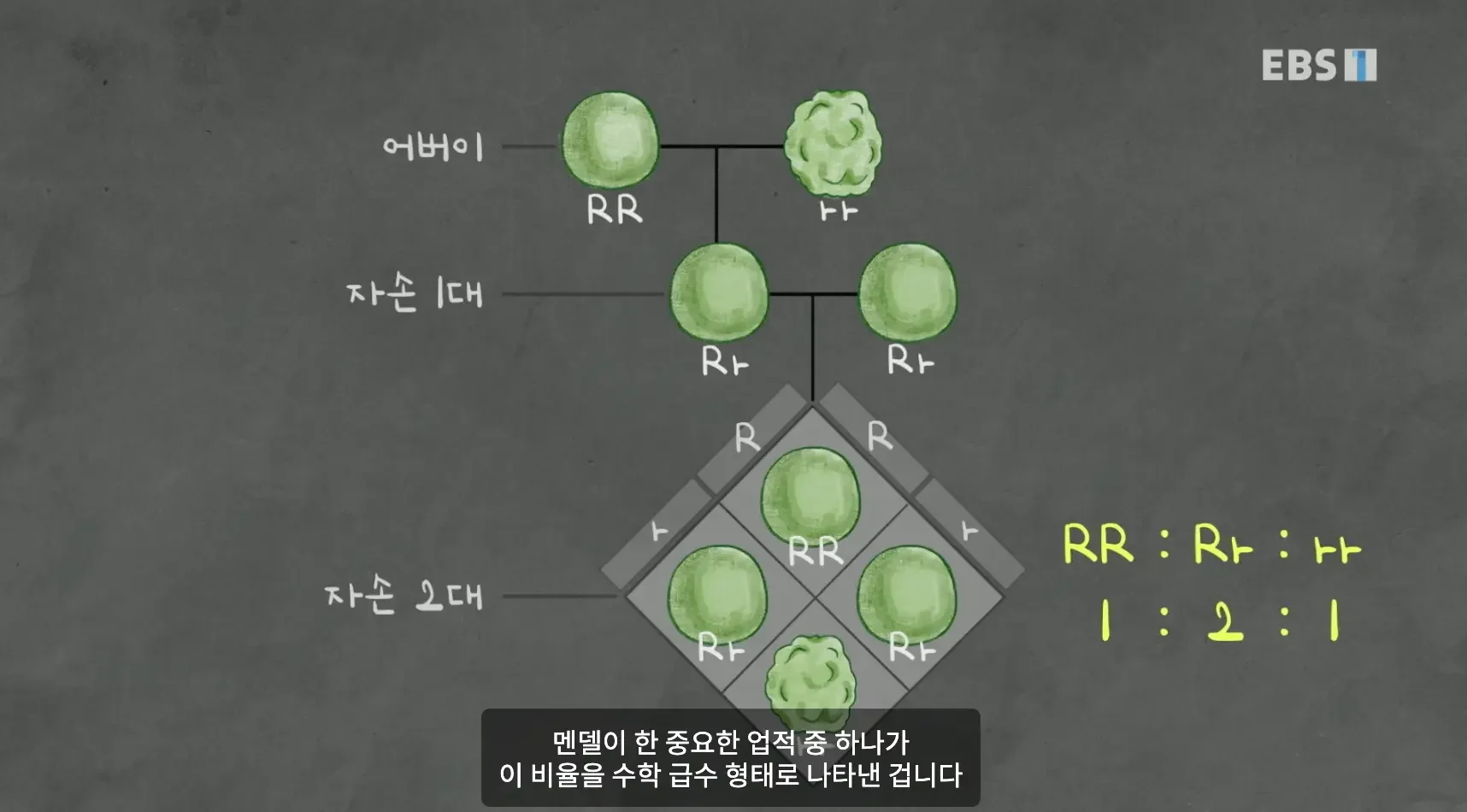
The many peas differed in height, flower color, seed shape, and many other traits. He discovered that when peas with or without specific traits were cross-bred, offspring could inherit parental traits in mathematical ratios.
The second concept is the gene. Heredity occurs through genes. According to Mendel's laws, inherited traits are determined by some form of particles that exist in pairs. All genes exist in pairs. We receive one from each biological parent. Genes are passed to us through the fertilization process where sperm and egg unite.
DNA consists of adenine paired with thymine, and cytosine paired with guanine, forming base pairs.
Lecture 1 Summary#
Five key concepts of life: Cell, Gene, Chemistry, Information, Evolution
Cell
- The structural and functional basic unit of life -> the atom of life
- Every cell is itself a living entity
- All living things are connected through cell division
- The simplest entity among living things
- Understanding cells is understanding life
- A physical entity separated from its environment (order inside the cell, disorder outside)
Gene
- The basis of heredity in all life
- Mendel's laws -> laid the foundation for genetics
- The particulate elements Mendel hypothesized -> genes
- The chemical substance that is inherited -> DNA
- Inherited traits are determined by particles that exist in pairs
- All living things pass genes through the reproductive process
History of gene discovery
1865: Mendel - First discovery of the principles of heredity
1900: De Vries, Correns, Tschermak - Discovery of Mendel's laws
1945: Avery - Discovery of DNA
1951: Franklin, Gosling - X-ray diffraction photograph of DNA
1953: Crick, Watson - Explained the principle of heredity through DNA double helix structure
Lecture 2: Life Is Chemistry!#
Lecture 2: Life Is Chemistry! A "chemical reaction" is one expression of the cell being alive. All these activities — helping metabolic processes in the body, moving millions of muscle cells, producing proteins from DNA, and obtaining life's energy source — all stem from chemical reactions. As a result, thousands of chemical reactions occur simultaneously and closely within tiny cells. How does the cell orchestrate all these chemical reactions in an orderly fashion? The key is "compartmentalization." Just as a city is divided by function, all chemical reactions inside a cell occur separately by function. Let's look into the principles of life — amazingly complex, yet ultimately understandable "chemical and physical machines."
The functions of living organisms are based on chemical reactions. This concept was conceived by French chemists. At the request of alcohol producers, Louis Pasteur conducted sugar beet fermentation experiments in northern France.
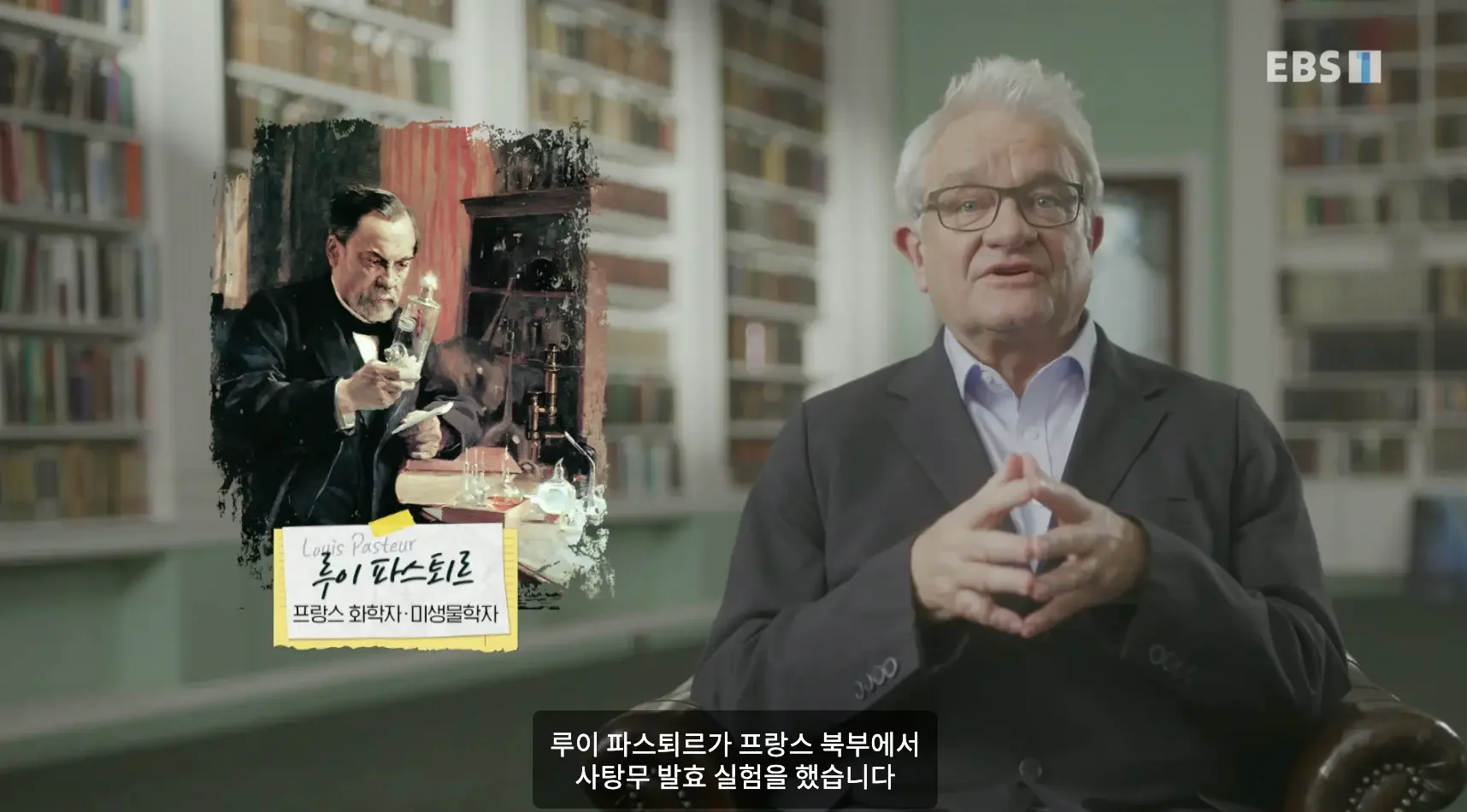
Sometimes the fermentation didn't go well and acid was produced instead. He discovered that when bacteria acted instead of yeast, acid was created during fermentation. Fermentation was a physiological process that produced substances for cells, and ultimately, chemical reactions were one expression of the life activities that cells perform.
Enzymes are catalysts that promote and accelerate chemical reactions. Most enzymes are made of proteins, which are long-chain polymers. Polymers form the basis of all substances found in living organisms — lipids, carbohydrates, nucleic acids like DNA and RNA. Carbon plays an important role in forming the polymers found in living things and other chemical polymers.
Living organisms use 20 types of amino acids to make proteins. Each amino acid has different molecules on its main chain side branches, giving it unique chemical properties. Some amino acids carry positive or negative charges, some attract or repel water, and some can easily bond with other molecules.
All the different chemical reactions must occur in close proximity inside the cell but must not interfere with each other. What makes this possible is compartmentalization. Compartmentalization makes all sorts of complex systems work well. Different chemical microenvironments must be separated from each other, whether physically in space or temporally. Living organisms build compartment systems that interact to make this possible.
The smallest chemical compartment within a cell is the surface of an enzyme molecule. Each enzyme protein molecule has a custom binding site designed so that a specific molecule can fit into it. It has just the right shape to mesh with and function well with a specific molecule. The enzyme and substrate fit together precisely.
Cells need energy to work, and they generate energy through a chemical process called cellular respiration. The final stage of this reaction occurs in another cell organelle called the mitochondria. The key step in securing energy during cellular respiration is driven by the movement of protons. A proton is a hydrogen atom that has lost one electron and carries a positive charge.
We are drowning in a sea of data while thirsting for knowledge.
— Nobel laureate Sydney Brenner
He was concerned that many biologists spend too much time meticulously recording and describing the complexity of life's chemical reactions without comprehensively understanding them. The key to converting all this data into useful knowledge is understanding how living things process information.
Lecture 2 Summary#
Chemical reactions
- Thousands of chemical reactions generated inside cells
- Chemical reactions are one expression of cellular life
- Cells need chemical environment separation
The precise chemical reactions of enzymes proceed under optimal chemical conditions
- Involved in various physical tasks such as chromosome separation and cell division
- Catalysts that promote chemical reactions
- Composed of protein polymers
- Generate chemical substances necessary for life activities
- Synthesize more complex molecules that make up living things
Carbon: Plays an important role in polymer formation
Polymers: Lipids, carbohydrates, nucleic acids — the core of living organisms
Proteins: Amino acid molecules bonded together. Carbon-based polymers
- Enzyme proteins: Perform chemical reactions by fitting with specific molecules
- Enzyme and substrate: The chemical substance that interacts with the enzyme
- Metabolic pathway: A series of chemical reactions where the product of one becomes the substrate of the next
- Motor proteins: Enzymes that perform physical work using the energy of chemical reactions
- All movement is the result of proteins working together
- Chemical processes of protein groups larger than individual enzymes and motor proteins
- Ribosome: A protein + RNA complex that synthesizes proteins
DNA and RNA 1D structure -> Translation to protein 3D structure
- Cells perform numerous chemical reactions through compartmentalization. Cells are complex but understandable chemical and physical machines
Lecture 3: Life Is an Information Device#
Lecture 3: Life Is an Information Device. Cells and other living organisms are very complex systems that require control and coordination. Without control and coordination, the complex systems of living organisms would fall into chaos. What makes control and coordination possible is life's information processing capability! If we understand life from the perspective of information, we can understand how such complex organisms can function as a whole. So how does life — neither a computer nor a machine — process information on its own? From how genes store and process information using the four letters of DNA to gene regulatory mechanisms, let's examine various examples of life's information processing. We'll also understand how three-dimensional biological structures are built from a single egg cell, from the perspective of information processing.
Life is a complex system. The first person to propose this idea was the philosopher Immanuel Kant.
Cells also have very complex systems and require control and coordination. Numerous chemical reactions and physical processes occur in each cell.
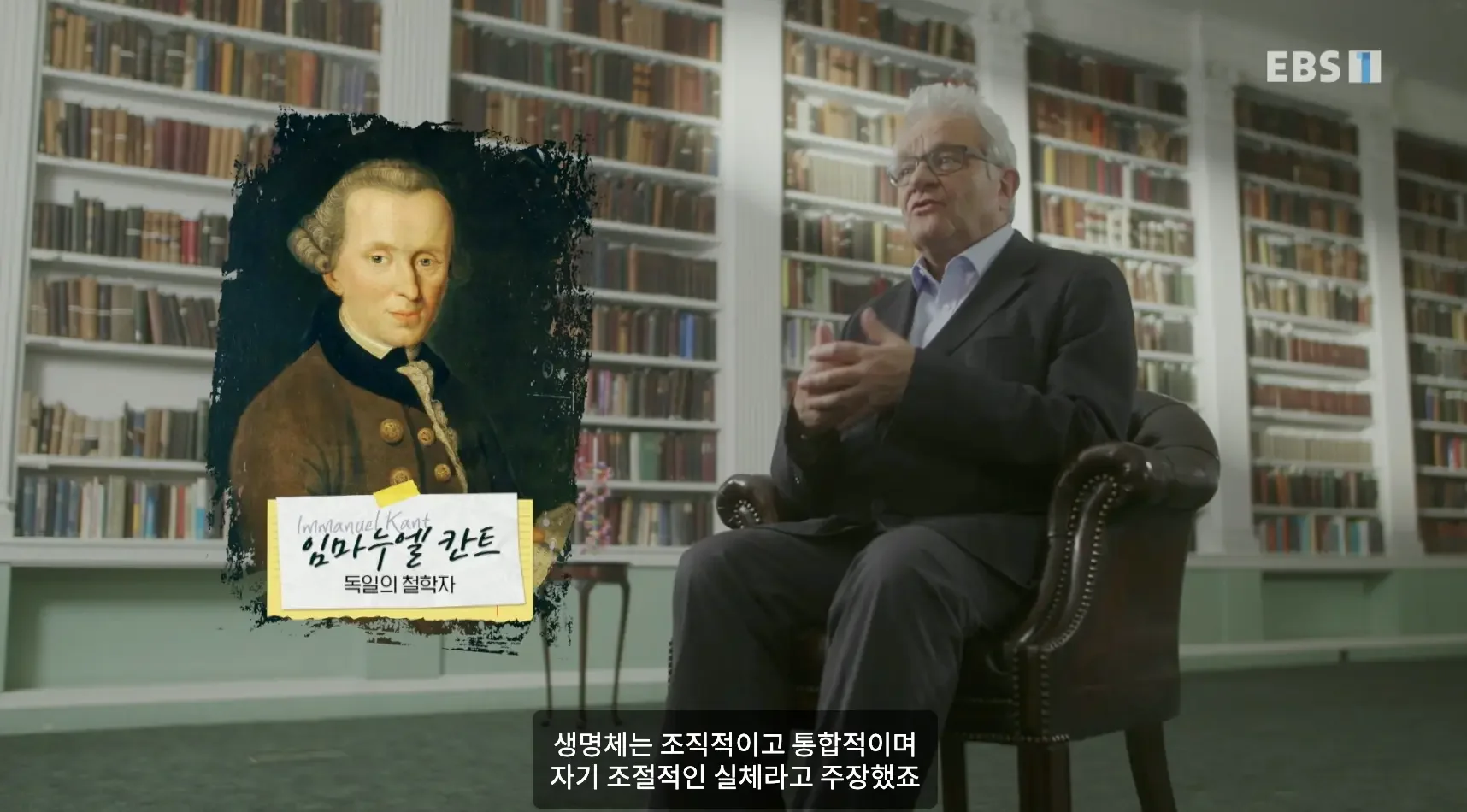
You need to know that cells are chemical and physical machines that function as a whole. Numerous chemical reactions must communicate with each other and cooperate closely. When the external environment and internal state change, cells can detect changes and adapt accordingly. In doing so, they maintain the overall system's function in the most optimal state possible. Cells constantly measure their internal and external chemical and physical environment and use that information to regulate their own state.
Through information processing, our bodies maintain homeostasis. Body temperature, blood volume, and blood sugar are kept constant. Information processing permeates every domain of life.
Let's look at the complex components and various processes of cells. The first is how DNA and its molecular structure explain heredity. An important fact about DNA is that each gene is information written in a single line, using four types of DNA bases.
When DNA code is translated through RNA into protein in a cell, the cell converts genetic information into physical action. This process can be explained through the central dogma concept — the way DNA encodes protein structure. The central dogma explains how the base sequence that makes up a gene is transcribed from DNA to RNA.
RNA serves as a messenger between the DNA in the cell nucleus (where chromosomes reside) and the cytoplasm (where proteins are made). The sequence of messenger RNA determines protein structure, with each protein being made from a single gene that encodes the information code.
DNA's linear polymer positions the coded base sequence inside the helix to protect the information from being altered. This information is then converted into the chemical action of proteins. Another important function of DNA — the ability to replicate itself accurately — also comes from this DNA molecular structure. When the genetic information stored in a DNA molecule is replicated, the molecular attraction between base pairs A and T, C and G allows DNA to make very accurate and reliable copies.
The second is the regulatory application of cellular chemical reactions. When a different sugar is provided, bacteria quickly activate suppressed genes to digest that sugar through a negative feedback loop — an information processing module — and a positive feedback loop module that forms an irreversible switch that stays on once activated. These information modules are tightly connected to form more sophisticated routines for processing information.
Cells use wet chemistry to connect various components. The wiring of cells and organisms is fluid and dynamic, because the cell's chemical substances diffuse through water, moving between the cell's components and compartments. Efficient information exchange must occur with the external environment. For information exchange, signaling pathways exist within cells, between cells, and between various tissues and organs.
Controlling the chemical reactions of organisms through information makes complex systems behave as a unified whole directed toward a purpose.
Lecture 3 Summary#
Information processing
- The cell is one massive chemical and physical machine
- Various chemical reactions and physical processes occur in complex ways within cells
- Cells process chemical and physical environmental data as information for self-regulation
- Information processing is what brings order to complex life activities
- Cell systems would be chaos without regulatory processes
- Life achieves its ultimate purpose through information processing
- Life achieves homeostasis (maintaining body temperature, blood volume, blood sugar) through information processing
Life's information processing
- DNA and the principle of heredity
- How DNA encodes protein structure
- Genetic information protected through the double helix structure
- Base pair genetic information is accurately replicated
- DNA genetic information -RNA translation-> protein physical action
- Regulation of cellular chemical reactions (gene regulation)
- Negative feedback loop
- Positive feedback loop
- Complex organism structures formed by simple protein gradients
- Uniform cell populations -information, chemical gradients-> complex structures
Lecture 4: The Mechanism of Evolution, Natural Selection#
Lecture 4: The Mechanism of Evolution, Natural Selection. The world is full of amazingly diverse living things. How did this complex life begin? For thousands of years, many believed life was created by a divine creator. But Charles Darwin sidestepped this belief with the great idea of "natural selection." Biological species have evolved on their own through natural selection, without a human designer or creator. Paul Nurse introduces Darwin's theory of evolution as the most beautiful fundamental concept in biology, explaining the "interconnectedness" of life. What characteristics must living things have for such beautiful evolution to be possible? Are all living things on Earth really connected through a single lineage?
The topic of this lecture is evolution through natural selection. The diversity of life can feel overwhelming. We live alongside countless animals, plants, fungi, and microorganisms. These organisms are well adapted to their own lifestyles and environments.
Natural selection is based on the fact that variant individuals exist within biological populations. If the cause of variation is genetic change, this variation is inherited by the next generation. When some of these prove advantageous for survival, certain individuals have higher survival rates. As a result, they can leave more offspring.
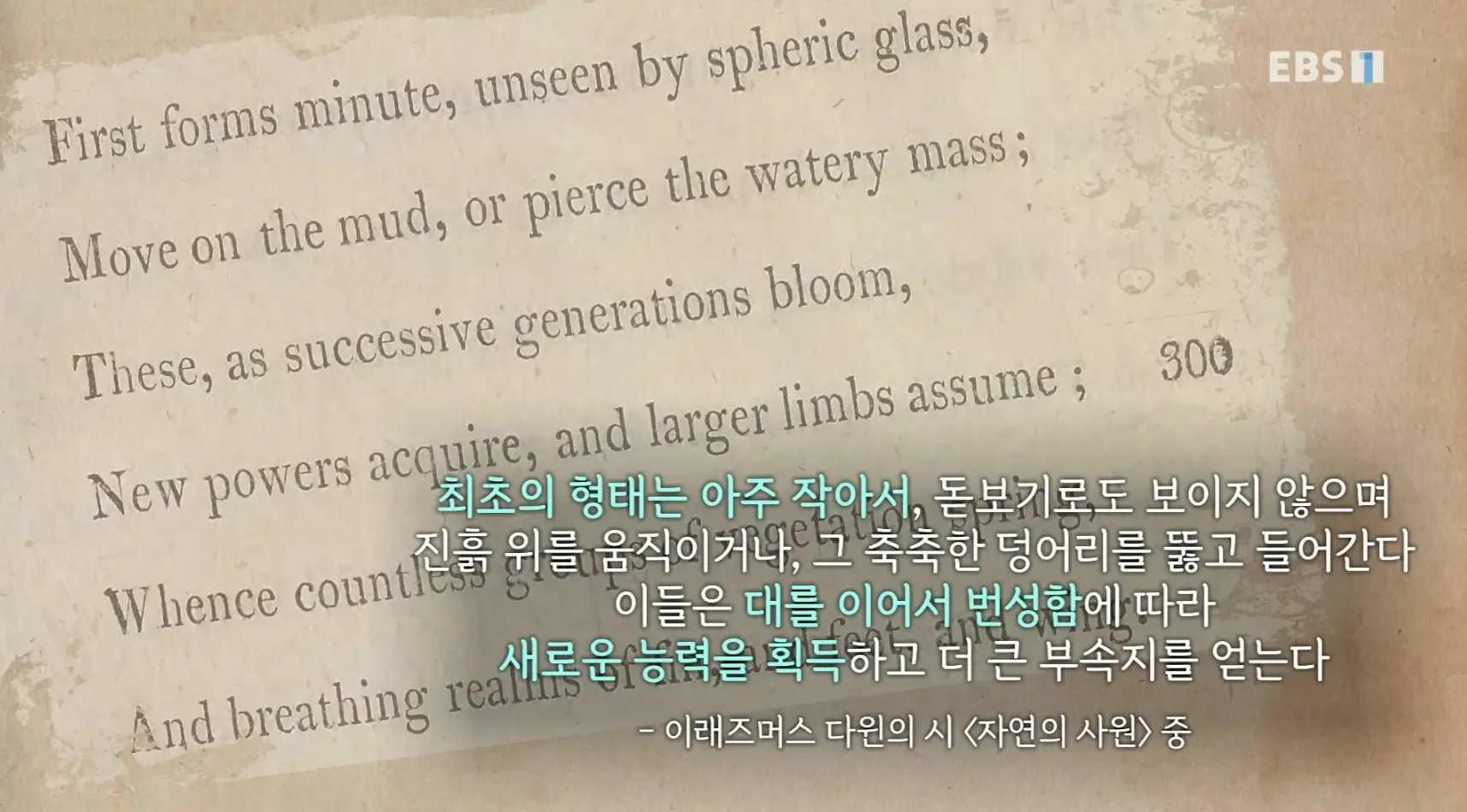
Through natural selection, species suited to their environment survive while less competitive individuals are eliminated. Individuals with specific genetic variations become more numerous within the population. As a result, completely changed traits in form and function appear in living species.
For evolution through natural selection to occur, living things must possess three important characteristics.
First, they must be able to reproduce.
Second, they must have a genetic system. This allows information determining biological traits to be copied and passed down to descendants.
Third, diversity must emerge from the genetic system, and this diversity must be passed down through reproduction.
Natural selection doesn't only occur during evolution. Natural selection also occurs at the cellular level in our bodies. Our bodies have important genes that control cell growth and division. When these are damaged or rearranged, cells divide uncontrollably and cancer develops.
Whilst this planet has gone cycling on according to the fixed law of gravity, from so simple a beginning endless forms most beautiful and most wonderful have been, and are being, evolved.
— Charles Darwin
Lecture 4 Summary#
Natural selection
- The mechanism of evolution proposed by Darwin
- Life's complexity -> the result of evolution through natural selection
- Genetic variation -> the foundation of natural selection theory
Natural selection -> survival of the fittest -> increased survival variants with advantageous traits
Conditions for evolution through natural selection
- Ability to reproduce
- Existence of a genetic system
- Expression of diversity (variation)
Darwin's theory of evolution -> all life is connected through lineage (phylogenetic relationships)
- All living things on Earth are our relatives
- Evolution through natural selection -> gives life complexity and purposefulness
- Evolution is the fundamental law of biology and the result of chance (variation) and necessity (survival of the fittest)
- Why humanity must protect the biosphere
Lecture 5: What Is Life?#
Lecture 5: What Is Life? The five key ideas of life — , , , , — are integrated to establish fundamental principles of life. What exactly is life? Paul Nurse defines anything that is a self-directed physical entity capable of evolving through natural selection as alive. In addition to the fundamental principles of life, he explains the chemistry that makes life on Earth work. By deriving that the operating principles of all living things are the same, Paul Nurse naturally shifts the discussion to the deep interconnectedness of living things — that life, connected from an origin that occurred only once on Earth, is all alive. In this final lecture, Paul Nurse emphasizes the connection of all living things and stresses that humanity bears a special responsibility.
The question of what life is isn't easy to answer. Let me establish the key principles needed to define life. These principles will give us a deeper understanding of how life works, how it began, and the relationships between all life on Earth. However, I should say upfront that we cannot define life concisely.
Living things are physical entities with boundaries. They are separated from their environment but simultaneously communicate with it. Living things organize chemical metabolic activities to sustain, grow, and reproduce themselves. Information management is needed to integrate all these functions.
Proteins are also carbon-based polymers, but unlike DNA, they have complex and variable three-dimensional structures. The chemically active sites in proteins are mostly located on the outside of the polymer molecule. This characteristic allows proteins to perform the various functions needed to sustain life and to maintain and reproduce chemical reactions. Also, unlike DNA, when proteins are damaged or destroyed, they can easily be replaced by newly made proteins.
The various arrangements of linear carbon polymers serve both as chemically stable information storage devices and generate highly diverse chemical activities.
I find this chemistry of life to be both extremely simple and truly mysterious. The way life connects information stored in linear polymers with the chemistry of complex polymers is so overwhelming that I suspect this principle is not only central to life on Earth but will also be importantly applicable to life elsewhere in the universe. While we and all known living things depend on carbon polymers, we shouldn't only consider the chemistry of life as we encounter it on Earth. Other life somewhere in the universe might use carbon in different ways or be based on different atoms like silicon instead of carbon.
All life on Earth is broadly connected to each other, forming one massive ecosystem. This fundamental connectivity means not only deep interdependence among organisms but also that all life is genetically related through common evolutionary roots.
Life has far greater similarity than diversity. The basic operating principles of organisms as chemical, physical, and informational machines are the same. These profound commonalities in life's chemical foundation lead to an amazing conclusion: life on Earth originated only once.
So how did life begin? The best answer we have is that life likely started through RNA rather than DNA or proteins.
Like DNA, RNA molecules can store information. RNA molecules can also be replicated. Errors occur in the process, generating diversity. This means RNA can serve as a genetic molecule capable of evolution. But another important characteristic of RNA molecules is that they can fold into complex three-dimensional structures and function as enzymes. RNA-based enzymes can't match protein enzymes in complexity or diversity, but they can catalyze specific chemical reactions. Therefore, RNA molecules can function as both genes and enzymes simultaneously. A genetic system and primitive metabolism in one package. This is why self-sustaining RNA-based life forms could have emerged.
The deeper we understand what life is, the greater the potential for human life to advance. Biology also tells us that all living things we know interact closely with each other. We are deeply connected to all other life. We must care for and look after life on Earth. To do that, we first need to understand life. I hope my lectures helped with that.
Lecture 5 Summary#
Principles of life
- Living things are physical entities with boundaries
- Living things evolve through natural selection
- Living things are chemical, physical, and informational machines
The core operating principle of life -> carbon polymer-centered life science
Representative carbon polymers -> information storage device, DNA -> chemical and physical machine, protein
"Carbon polymers that enable both information storage and chemical activity"
Carbon polymer, DNA
- Serves as a long-term genetic information repository
- DNA genetic information needs to be activated for life activities
Carbon polymer, protein
- Performs chemical reactions essential for life activities
- Complex and variable 3D structures activate chemical activity
- Easily replaceable even when damaged or destroyed
Virus (an intermediate between life and non-life)
- A chemical entity with a genome (life)
- Capable of evolution through natural selection (life)
- Cannot reproduce on its own (non-life)
What is life?
- A self-directed physical entity capable of evolution
- All life is one interconnected ecosystem
- Not only interdependent but genetically connected (the connectivity of life)
- Humanity is the only living thing capable of understanding life's connectivity
- Understanding life improves human existence
Irrigators channel waters; fletchers straighten arrows; carpenters bend wood; the wise master themselves.
— The Buddha