
Week 6#
Finally, this is the last study group homework. If I had done this alone, it would have taken a really long time to read this book.
The structure of having commitments with others and reading a set amount within a set period will definitely help when reading books in the future.
C14#
Swapping is a memory management technique that sends unused processes from memory to secondary storage and brings processes that need to execute into memory.
First fit is a method that places a process in the first available empty space found.
Best fit is a method that places a process in the smallest available space where the process can be loaded.
Worst fit is a method that places a process in the largest available space where the process can be loaded.
External fragmentation refers to the phenomenon where memory is wasted due to memory spaces that are too small to allocate a process.
Paging is a virtual memory management technique that divides the physical address space into frames, divides the process's logical address space into pages, and then assigns each page to a frame.
Page tables allow you to find the frame where a page is loaded. Page tables contain not only page numbers and frame numbers, but also valid bits, protection bits, access bits, modified bits, and more.
PTBR points to the address where each process's page table is loaded.
TLB stores a portion of the page table to serve as a cache memory for the page table.
Demand paging is a technique that loads pages into memory only when they are needed.
Page replacement algorithms include FIFO, optimal, and LRU page replacement algorithms.
Thrashing refers to the problem where CPU utilization drops due to excessively frequent page replacements.
Frame allocation methods include equal allocation, proportional allocation, working set model-based allocation, and page fault rate-based allocation.
C15#
A file is a logical unit that collects meaningful and related information.
The operating system can identify the type of a file through its extension.
A file's attributes contain various supplementary information related to the file.
Directories allow you to group and manage multiple files or directories.
A path is information that specifies a location using directories.
An absolute path starts from the root directory, while a relative path starts from the current directory.
Partitioning refers to the process of dividing a large-capacity storage device like a hard disk or SSD into one or more logical units.
Formatting refers to the process of setting up a file system to determine how files will be stored and managed, and enabling new data to be written.
Contiguous allocation is a method that allocates files to consecutive blocks in secondary storage.
Linked allocation is a method that stores the address of the next block in a portion of each block, managing blocks in a linked list format.
Indexed allocation is a method that gathers all block addresses of a file into an index block for management.
FAT file system is a linked allocation-based file system that uses FAT.
Unix file system is an indexed allocation-based file system that uses i-nodes.
Homework#
p. 400, Review Question 1 (Required)#
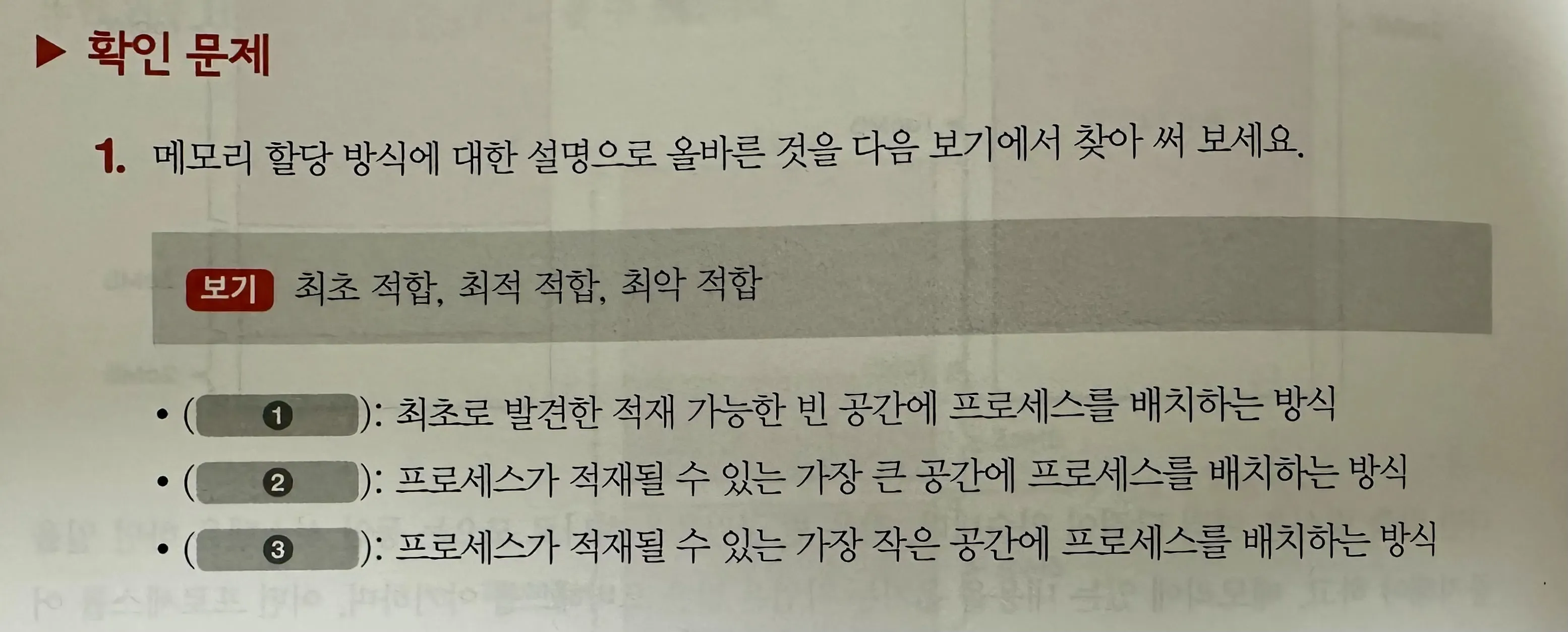
Answers
- First fit
- Worst fit
- Best fit
Additional Homework (Optional)#
Ch.14 (14-3) If a process has 3 available frames and the page reference string is '2313523423', how many page faults occur when referencing these pages using the LRU page replacement algorithm?
Answer: 6 page faults occur / Only 3 if counting just the changed parts
- 2: Empty -> [2] (page fault)
- 3: [2] -> [2,3] (page fault)
- 1: [2,3] -> [2,3,1] (page fault)
- 3: [2,3,1] -> [2,1,3] (already exists, order changed)
- 5: [2,1,3] -> [1,3,5] (page fault, 2 is least recently used so it gets replaced)
- 2: [1,3,5] -> [3,5,2] (page fault, 1 is least recently used so it gets replaced)
- 3: [3,5,2] -> [5,2,3] (already exists, order changed)
- 4: [5,2,3] -> [2,3,4] (page fault, 5 is least recently used so it gets replaced)
- 2: [2,3,4] -> [3,4,2] (already exists, order changed)
- 3: [3,4,2] -> [4,2,3] (already exists, order changed)
But I'll tell you what hermits realize. If you go off into a far, far forest and get very quiet, you'll come to understand that you're connected with everything.
— Alan Watts