
Week 3#
I got a snack from the Hongong group leader during Week 2, which made me so happy! You submit by posting a link on Facebook, and they always leave warm comments for the participants — it's really touching. It gives me the energy to keep reading the book!!
C06#
RAM is a volatile storage device, and secondary storage is a non-volatile storage device.
DRAM is RAM where stored data gradually disappears over time, and SRAM is RAM where stored data doesn't disappear over time.
SDRAM is DRAM synchronized with the clock.
DDR SDRAM has twice the bandwidth compared to SDR SDRAM.
A physical address is the address on the memory hardware, and a logical address is the address used by the CPU and running programs.
The MMU converts logical addresses to physical addresses.
The base register stores the first physical address of a program.
The limit register stores the maximum size of a running program's logical address.
The storage hierarchy is a structure that layers storage devices of different capacities and performance levels.
Cache memory is a storage device designed to reduce the gap between CPU processing speed and memory access speed.
A higher cache hit rate reduces the number of CPU memory access attempts.
Cache memory uses the principle of locality (temporal locality, spatial locality) to predict data and increase the cache hit rate.
C07#
Hard disk components include platters, spindles, heads, and disk arms.
Platters are divided into tracks and sectors, and identical tracks across multiple platters form a cylinder.
Hard disk data access time is broadly divided into seek time, rotational latency, and transfer time.
Flash memory is categorized as SLC, MLC, or TLC based on how many bits can be stored per cell.
Flash memory reads and writes are done in page units, and erasures are done in block units.
RAID is a technology that uses multiple hard disks or SSDs as if they were a single device for data stability or high performance.
RAID 0 simply distributes data in parallel, and RAID 1 creates a complete copy.
RAID 4 uses a separate device to store parity, and RAID 5 distributes parity across devices.
RAID 6 uses two different parities.
C08#
I/O devices exchange information with the computer's internals through device controllers.
A device driver is a program that enables device controllers to exchange information with the computer's internals.
Programmed I/O is a method of performing I/O operations through program instructions.
Memory-mapped I/O treats the address space for accessing memory and the address space for accessing I/O devices as a single address space.
Isolated I/O separates the address space for accessing memory from the address space for accessing I/O devices.
Interrupt-driven I/O is a method of performing I/O using interrupts.
DMA I/O is an I/O method where data is exchanged between memory and I/O devices without going through the CPU.
The I/O bus is a pathway connecting I/O devices to the computer's internals, reducing the number of system bus uses during I/O operations.
Homework#
p. 185 Review Question 3 (Required)#
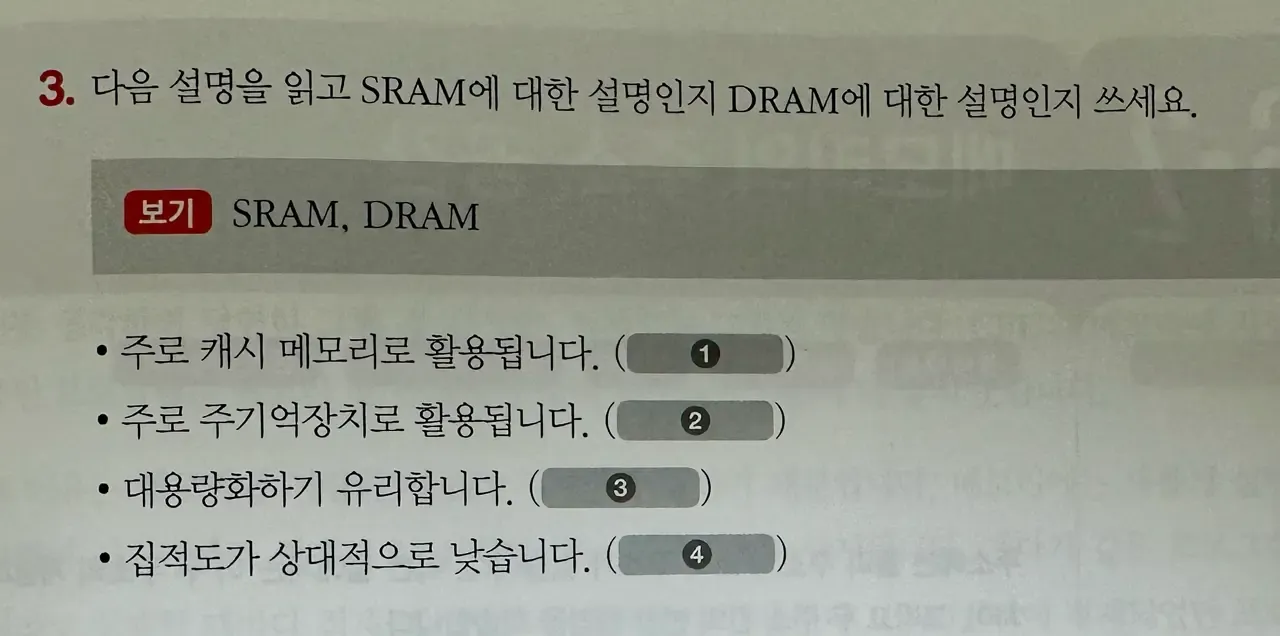
Answers:
- SRAM
- DRAM
- DRAM
- SRAM
p. 205 Review Question 1 (Required)#
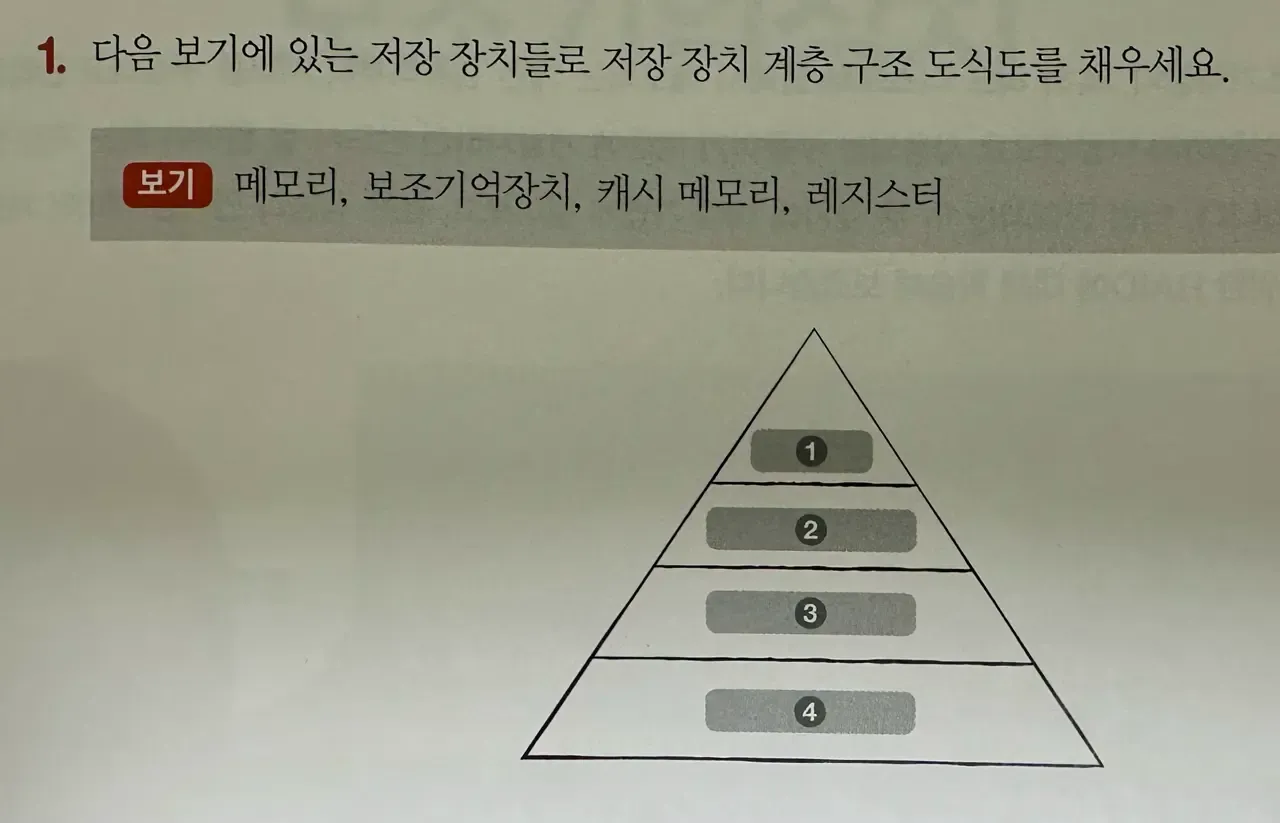
Answers:
- Register
- Cache memory
- Memory
- Secondary storage
Ch.07(07-2) RAID Definition and Types Summary (Optional)#
RAID (Redundant Array of Independent Disks) is a technology primarily using hard disks and SSDs, where multiple physical secondary storage devices are used as if they were a single logical secondary storage device for data stability or high performance.
RAID configuration methods are expressed as RAID levels. There are RAID 0 through RAID 6, as well as RAID 10, RAID 50, etc.
RAID 0 simply divides data across multiple secondary storage devices.
RAID 1 creates copies — also called mirroring.
RAID 2 and RAID 3 are methods not commonly used today.
RAID 4 stores error detection and recovery information on a dedicated device instead of creating complete copies like RAID 1.
RAID 5 resolves the bottleneck issue of RAID 4 where the parity storage device became a bottleneck. It distributes parity information across devices.
RAID 6 is basically the same as RAID 5 but uses two different parities.
RAID 10 is a hybrid of RAID 0 and RAID 1.
RAID 50 is a hybrid of RAID 0 and RAID 5. These hybrid approaches are called Nested RAID.
What you do not want done to yourself, do not do to others.
— Confucius