
Week 2#
C04#
The ALU receives operands from registers and control signals from the control unit.
The ALU outputs operation results and flags.
The control unit receives the clock, the current instruction to execute, flags, and control signals.
The control unit sends control signals both inside and outside the CPU.
The program counter stores the address of the next instruction to fetch from memory, and the instruction register stores the instruction to be interpreted.
The memory address register stores memory addresses, and the memory buffer register stores data to be exchanged with memory.
General-purpose registers store both data and addresses, and the flag register stores supplementary information about operation results or CPU status.
The stack pointer stores the position of the top of the stack.
The address stored in the base register serves as a base address.
The instruction cycle is the cycle in which a single instruction is processed, consisting of the fetch, execute, indirect, and interrupt cycles.
An interrupt is a signal that disrupts the CPU's normal operation.
Types of interrupts include exceptions and hardware interrupts.
An interrupt service routine is a program consisting of the actions taken to handle an interrupt.
C05#
A CPU with a higher clock speed operates faster.
A core is the component within the CPU that executes instructions.
A multi-core processor is a CPU that contains multiple cores.
Threads include hardware threads and software threads.
A multi-threaded processor is a CPU that can execute multiple instructions simultaneously with a single core.
Instruction pipelining is a technique that overlaps the execution of multiple instructions simultaneously.
Superscalar is a technique that uses multiple instruction pipelines.
Out-of-order execution is a technique that processes instructions out of order to prevent pipeline stalls.
ISA is the language of the CPU and the agreement on how hardware understands software.
CISC uses a complex and diverse set of variable-length instructions.
RISC uses a simple and limited set of fixed-length instructions.
Homework#
p. 125 Review Question 2 (Required)#
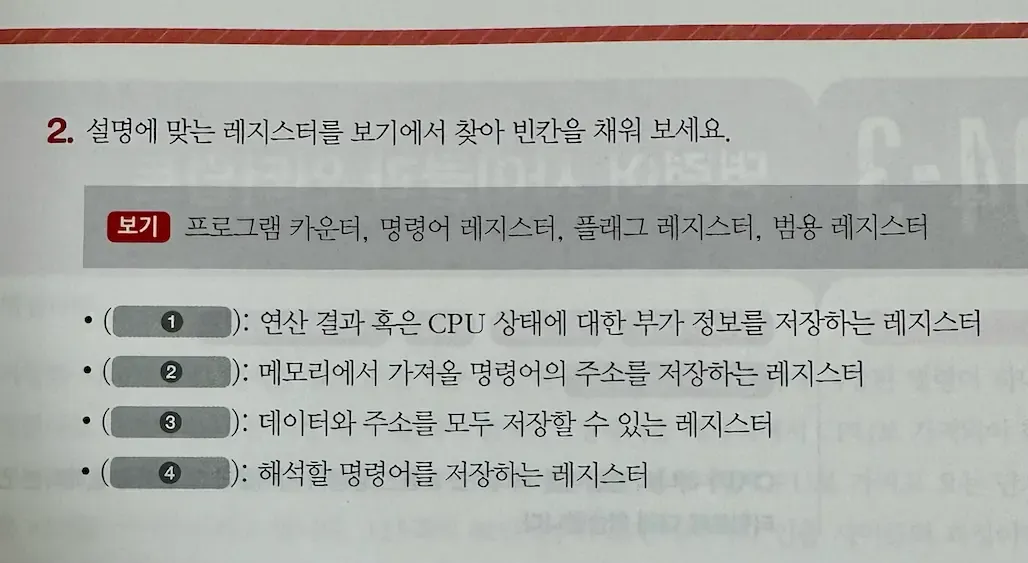
Answers:
- Flag register
- Program counter
- General-purpose register
- Instruction register
p. 155 Review Question 4 (Required)#
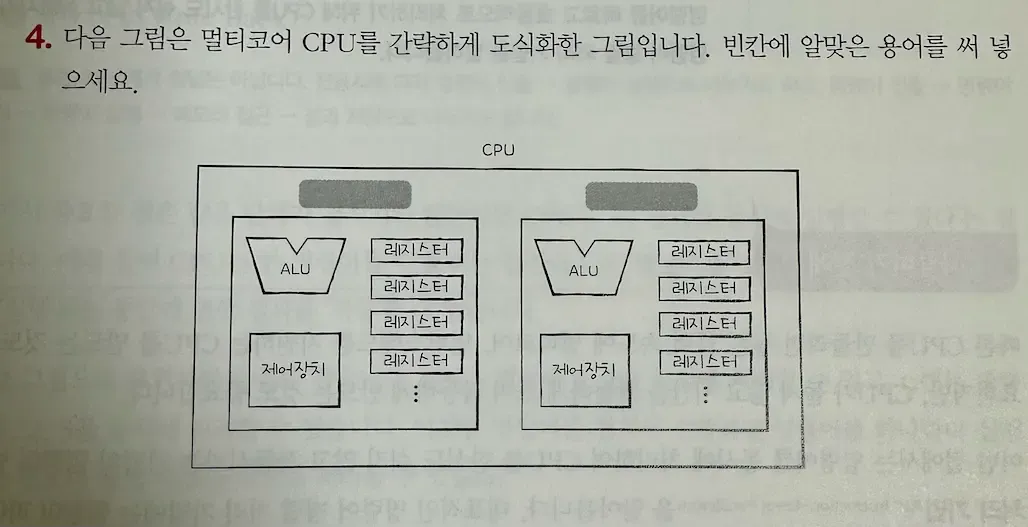
Answer: Core
Ch.05(05-1) Core and Thread, Multi-core and Multi-thread Concept Summary (Optional)#
A core is the component within the CPU that executes instructions.
Threads include hardware threads and software threads.
A multi-core processor is a CPU that contains multiple cores.
A multi-threaded processor is a CPU that can execute multiple instructions simultaneously with a single core.
It isn't where you come from, it's where you're going that counts.
— Ella Fitzgerald